Contour plowing

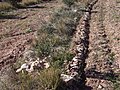
Contour plowing, also known as contour farming, is an agricultural practice that involves plowing and planting across a slope following its elevation contour lines. These contour lines create a water break, which reduces the formation of gullies during rainstorms by allowing the water to flow down the slope in a controlled manner. The primary goal of contour plowing is to conserve rainwater and reduce soil erosion, which are critical components in sustainable agriculture.
Overview[edit]
Contour plowing is most effective on slopes between 2% and 10%. The method involves plowing, planting, and cultivating in a pattern that runs perpendicular to the natural slope of the land, rather than up and down the slope. This technique helps to create natural barriers for water flow, significantly reducing the speed of water runoff and encouraging water infiltration into the soil. As a result, contour plowing can help to preserve valuable topsoil, improve soil moisture levels, and reduce the risk of soil erosion.
Benefits[edit]
The benefits of contour plowing are numerous. By reducing runoff, this practice helps to conserve water and protect against drought. It also minimizes soil erosion, which is beneficial for maintaining soil health and fertility. Furthermore, contour plowing can increase crop yields by improving water availability to plants and reducing water and wind erosion. Additionally, this method contributes to the reduction of sedimentation in nearby water bodies, which can have positive effects on aquatic ecosystems.
Implementation[edit]
To implement contour plowing, farmers first need to determine the contour lines of their fields. This can be done using traditional surveying tools or modern GPS technology. Once the contour lines are established, the land can be plowed along these lines. It is important for farmers to maintain the contour lines with each subsequent planting to ensure the effectiveness of the technique.
Challenges[edit]
Despite its benefits, contour plowing presents several challenges. It requires careful planning and execution, as incorrect implementation can lead to reduced effectiveness or even exacerbate erosion problems. Additionally, contour plowing can be more labor-intensive and time-consuming than traditional plowing methods, which may deter some farmers from adopting the practice.
Environmental Impact[edit]
Contour plowing has a positive impact on the environment. By reducing soil erosion and runoff, it helps to maintain healthier soil and water ecosystems. This practice also contributes to carbon sequestration in the soil, which can help mitigate climate change by reducing atmospheric CO2 levels.
Conclusion[edit]
Contour plowing is a valuable agricultural practice that offers significant benefits for soil conservation, water management, and crop production. Despite its challenges, the adoption of contour plowing can lead to more sustainable farming practices and a healthier environment.

This article is a agriculture stub. You can help WikiMD by expanding it!
-
 Contour plowing
 -
 Contour line
 -
 Chlorbenzoxamine synthesis


Ad. Transform your health with W8MD Weight Loss, Sleep & MedSpa

Tired of being overweight?
Special offer:
Budget GLP-1 weight loss medications
- Semaglutide starting from $29.99/week and up with insurance for visit of $59.99 and up per week self pay.
- Tirzepatide starting from $45.00/week and up (dose dependent) or $69.99/week and up self pay
✔ Same-week appointments, evenings & weekends
Learn more:
- GLP-1 weight loss clinic NYC
- W8MD's NYC medical weight loss
- W8MD Philadelphia GLP-1 shots
- Philadelphia GLP-1 injections
- Affordable GLP-1 shots NYC
|
WikiMD Medical Encyclopedia |
Medical Disclaimer: WikiMD is for informational purposes only and is not a substitute for professional medical advice. Content may be inaccurate or outdated and should not be used for diagnosis or treatment. Always consult your healthcare provider for medical decisions. Verify information with trusted sources such as CDC.gov and NIH.gov. By using this site, you agree that WikiMD is not liable for any outcomes related to its content. See full disclaimer.
Credits:Most images are courtesy of Wikimedia commons, and templates, categories Wikipedia, licensed under CC BY SA or similar.
Translate this page: - East Asian
中文,
日本,
한국어,
South Asian
हिन्दी,
தமிழ்,
తెలుగు,
Urdu,
ಕನ್ನಡ,
Southeast Asian
Indonesian,
Vietnamese,
Thai,
မြန်မာဘာသာ,
বাংলা
European
español,
Deutsch,
français,
Greek,
português do Brasil,
polski,
română,
русский,
Nederlands,
norsk,
svenska,
suomi,
Italian
Middle Eastern & African
عربى,
Turkish,
Persian,
Hebrew,
Afrikaans,
isiZulu,
Kiswahili,
Other
Bulgarian,
Hungarian,
Czech,
Swedish,
മലയാളം,
मराठी,
ਪੰਜਾਬੀ,
ગુજરાતી,
Portuguese,
Ukrainian
