Arctostaphylos uva-ursi
Series of six paired embryological vascular structures
The aortic arches are a series of six paired embryological vascular structures that give rise to several major arteries in the adult. These arches are part of the pharyngeal arches and are crucial in the development of the circulatory system in vertebrates. In humans, these structures are transient and undergo significant remodeling to form the great arteries of the heart.
Development[edit]
The aortic arches develop from the aortic sac, which is an extension of the truncus arteriosus. Each arch is associated with a corresponding pharyngeal arch and is initially symmetrical on both sides of the embryo. As development progresses, these arches undergo complex transformations, with some regressing and others forming the major arteries of the body.
First Aortic Arch[edit]
The first aortic arch largely regresses, but it contributes to the formation of the maxillary artery, which supplies the deep structures of the face.
Second Aortic Arch[edit]
The second aortic arch also regresses significantly, with remnants forming the stapedial artery in the embryo, which is not present in adults.
Third Aortic Arch[edit]
The third aortic arch is crucial as it forms the common carotid arteries and the proximal portion of the internal carotid arteries.
Fourth Aortic Arch[edit]
The fourth aortic arch has different fates on the left and right sides. On the left, it forms part of the aortic arch itself, while on the right, it contributes to the formation of the right subclavian artery.
Fifth Aortic Arch[edit]
The fifth aortic arch is either rudimentary or absent in humans and does not contribute to any major adult structures.
Sixth Aortic Arch[edit]
The sixth aortic arch is also known as the pulmonary arch. On the left side, it forms the ductus arteriosus and part of the pulmonary arteries. On the right side, it contributes to the formation of the right pulmonary artery.
Clinical Significance[edit]
Abnormal development of the aortic arches can lead to congenital anomalies such as coarctation of the aorta, interrupted aortic arch, and vascular rings. These conditions can have significant clinical implications, often requiring surgical intervention.
Related pages[edit]
Gallery[edit]
-
 Diagram of the aortic arches in a human embryo.
 -
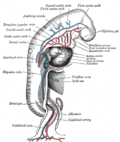 Illustration showing the transformation of the aortic arches.
 -
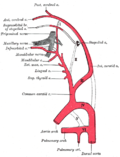 Development of the aortic arches and their derivatives.


Arctostaphylos uva-ursi[edit]

Ad. Transform your health with W8MD Weight Loss, Sleep & MedSpa

Tired of being overweight?
Special offer:
Budget GLP-1 weight loss medications
- Semaglutide starting from $29.99/week and up with insurance for visit of $59.99 and up per week self pay.
- Tirzepatide starting from $45.00/week and up (dose dependent) or $69.99/week and up self pay
✔ Same-week appointments, evenings & weekends
Learn more:
- GLP-1 weight loss clinic NYC
- W8MD's NYC medical weight loss
- W8MD Philadelphia GLP-1 shots
- Philadelphia GLP-1 injections
- Affordable GLP-1 shots NYC
|
WikiMD Medical Encyclopedia |
Medical Disclaimer: WikiMD is for informational purposes only and is not a substitute for professional medical advice. Content may be inaccurate or outdated and should not be used for diagnosis or treatment. Always consult your healthcare provider for medical decisions. Verify information with trusted sources such as CDC.gov and NIH.gov. By using this site, you agree that WikiMD is not liable for any outcomes related to its content. See full disclaimer.
Credits:Most images are courtesy of Wikimedia commons, and templates, categories Wikipedia, licensed under CC BY SA or similar.
Translate this page: - East Asian
中文,
日本,
한국어,
South Asian
हिन्दी,
தமிழ்,
తెలుగు,
Urdu,
ಕನ್ನಡ,
Southeast Asian
Indonesian,
Vietnamese,
Thai,
မြန်မာဘာသာ,
বাংলা
European
español,
Deutsch,
français,
Greek,
português do Brasil,
polski,
română,
русский,
Nederlands,
norsk,
svenska,
suomi,
Italian
Middle Eastern & African
عربى,
Turkish,
Persian,
Hebrew,
Afrikaans,
isiZulu,
Kiswahili,
Other
Bulgarian,
Hungarian,
Czech,
Swedish,
മലയാളം,
मराठी,
ਪੰਜਾਬੀ,
ગુજરાતી,
Portuguese,
Ukrainian
