Silicon tetrafluoride
Silicon tetrafluoride is a chemical compound with the formula SiF4. This tetrahedral molecule is notable for its role in the production of silicon and fluorine containing compounds, as well as its applications in microelectronics and glass manufacturing. Silicon tetrafluoride is a colorless, corrosive gas that is highly reactive, especially with water, where it forms hydrofluoric acid (HF) and silicon dioxide (SiO2).
Properties[edit]
Silicon tetrafluoride is characterized by its strong bonding between silicon and fluorine atoms, which contributes to its high reactivity. It has a boiling point of -86°C and a melting point of -90.8°C. Being a gas at room temperature, it poses risks such as corrosion and toxicity, necessitating careful handling and storage.
Production[edit]
The production of silicon tetrafluoride can be achieved through several methods, the most common being the reaction of silicon dioxide (SiO2) with hydrofluoric acid (HF). This process not only yields silicon tetrafluoride but also can lead to the formation of hexafluorosilicic acid (H2SiF6), depending on the reaction conditions.
Applications[edit]
Silicon tetrafluoride has various applications, primarily in the production of semiconductors and optical fibers. In the semiconductor industry, it is used in the deposition of silicon-containing films. In the glass industry, it serves as a source of fluorine for the manufacture of fluorine-doped glasses, which are essential for high-speed fiber optics.
Safety[edit]
Due to its reactivity, especially with water, silicon tetrafluoride requires stringent safety measures. Upon contact with moisture, it rapidly hydrolyzes to form hydrofluoric acid, a highly corrosive and toxic substance that poses significant health risks upon exposure.
Environmental Impact[edit]
The environmental impact of silicon tetrafluoride is primarily associated with its potential to release hydrofluoric acid upon hydrolysis. This acidification can lead to detrimental effects on soil and water quality, highlighting the need for careful management of silicon tetrafluoride emissions and waste.

-
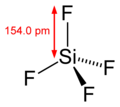 Silicon tetrafluoride 2D dimensions

Ad. Transform your life with W8MD's
GLP-1 weight loss injections special from $29.99 with insurance
|
WikiMD Medical Encyclopedia |
Medical Disclaimer: WikiMD is for informational purposes only and is not a substitute for professional medical advice. Content may be inaccurate or outdated and should not be used for diagnosis or treatment. Always consult your healthcare provider for medical decisions. Verify information with trusted sources such as CDC.gov and NIH.gov. By using this site, you agree that WikiMD is not liable for any outcomes related to its content. See full disclaimer.
Credits:Most images are courtesy of Wikimedia commons, and templates, categories Wikipedia, licensed under CC BY SA or similar.
Translate this page: - East Asian
中文,
日本,
한국어,
South Asian
हिन्दी,
தமிழ்,
తెలుగు,
Urdu,
ಕನ್ನಡ,
Southeast Asian
Indonesian,
Vietnamese,
Thai,
မြန်မာဘာသာ,
বাংলা
European
español,
Deutsch,
français,
Greek,
português do Brasil,
polski,
română,
русский,
Nederlands,
norsk,
svenska,
suomi,
Italian
Middle Eastern & African
عربى,
Turkish,
Persian,
Hebrew,
Afrikaans,
isiZulu,
Kiswahili,
Other
Bulgarian,
Hungarian,
Czech,
Swedish,
മലയാളം,
मराठी,
ਪੰਜਾਬੀ,
ગુજરાતી,
Portuguese,
Ukrainian
