Tumour heterogeneity
Tumour Heterogeneity[edit]
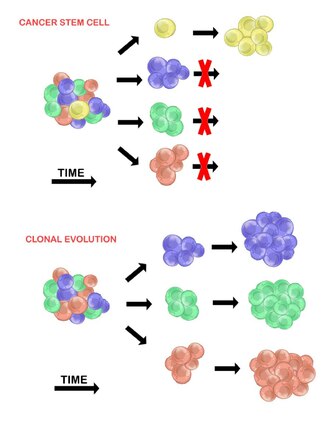
Tumour heterogeneity refers to the existence of distinct subpopulations of cells within a tumour, which can differ in their genetic, phenotypic, and behavioural characteristics. This diversity within a tumour can have significant implications for cancer diagnosis, treatment, and prognosis.
Types of Heterogeneity[edit]
Tumour heterogeneity can be broadly classified into two types: intertumoural heterogeneity and intratumoural heterogeneity.
Intertumoural Heterogeneity[edit]
Intertumoural heterogeneity refers to the differences between tumours in different patients. These differences can arise due to variations in genetic mutations, environmental factors, and the tumour microenvironment.
Intratumoural Heterogeneity[edit]
Intratumoural heterogeneity describes the diversity of cancer cells within a single tumour. This can result from genetic mutations, epigenetic changes, and differences in the tumour microenvironment. Intratumoural heterogeneity is a major challenge for effective cancer treatment, as different subpopulations of cells may respond differently to therapies.
Models of Tumour Heterogeneity[edit]
There are several models that attempt to explain the development of tumour heterogeneity:
Cancer Stem Cell Model[edit]
The cancer stem cell (CSC) model suggests that a subset of cancer cells, known as cancer stem cells, are responsible for tumour growth and heterogeneity. These cells have the ability to self-renew and differentiate into various cell types within the tumour.
Stochastic Model[edit]
The stochastic model proposes that all cancer cells have the potential to contribute to tumour growth and heterogeneity, with differences arising from random mutations and environmental influences.
Evolutionary Models[edit]
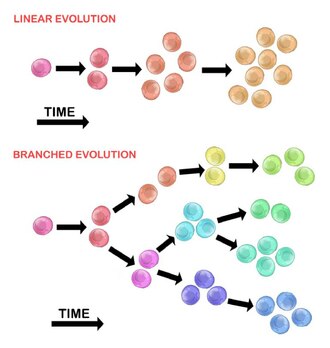
Tumour evolution can be described by linear or branched models. In the linear model, mutations accumulate sequentially, while in the branched model, different subclones evolve independently, leading to a more complex pattern of heterogeneity.
Implications for Treatment[edit]

Tumour heterogeneity poses significant challenges for cancer treatment. The presence of diverse subpopulations within a tumour can lead to treatment resistance, as some cells may survive and repopulate the tumour after therapy. Understanding and targeting tumour heterogeneity is crucial for developing more effective treatment strategies.
Related Pages[edit]
References[edit]
Ad. Transform your health with W8MD Weight Loss, Sleep & MedSpa

Tired of being overweight?
Get started with evidence based, physician-supervised
affordable GLP-1 weight loss injections
Now available in New York City and Philadelphia:
- Semaglutide starting from $59.99/week and up
- Tirzepatide starting from $69.99/week and up (dose dependent)
✔ Evidence-based medical weight loss ✔ Insurance-friendly visits available ✔ Same-week appointments, evenings & weekends
Learn more:
Start your transformation today with W8MD weight loss centers.
|
WikiMD Medical Encyclopedia |
Medical Disclaimer: WikiMD is for informational purposes only and is not a substitute for professional medical advice. Content may be inaccurate or outdated and should not be used for diagnosis or treatment. Always consult your healthcare provider for medical decisions. Verify information with trusted sources such as CDC.gov and NIH.gov. By using this site, you agree that WikiMD is not liable for any outcomes related to its content. See full disclaimer.
Credits:Most images are courtesy of Wikimedia commons, and templates, categories Wikipedia, licensed under CC BY SA or similar.
Translate this page: - East Asian
中文,
日本,
한국어,
South Asian
हिन्दी,
தமிழ்,
తెలుగు,
Urdu,
ಕನ್ನಡ,
Southeast Asian
Indonesian,
Vietnamese,
Thai,
မြန်မာဘာသာ,
বাংলা
European
español,
Deutsch,
français,
Greek,
português do Brasil,
polski,
română,
русский,
Nederlands,
norsk,
svenska,
suomi,
Italian
Middle Eastern & African
عربى,
Turkish,
Persian,
Hebrew,
Afrikaans,
isiZulu,
Kiswahili,
Other
Bulgarian,
Hungarian,
Czech,
Swedish,
മലയാളം,
मराठी,
ਪੰਜਾਬੀ,
ગુજરાતી,
Portuguese,
Ukrainian
