VSEPR theory
VSEPR theory (Valence Shell Electron Pair Repulsion theory) is a model used in chemistry to predict the geometry of individual molecules from the number of electron pairs surrounding their central atoms. The theory is based on the idea that electron pairs around a central atom will arrange themselves as far apart as possible to minimize repulsion.
History
The VSEPR model was first proposed by Ronald Gillespie and Ronald Nyholm in 1957. It was developed to explain the shapes of molecules and ions that could not be described by the Lewis structure model alone.
Basic Principles
The VSEPR theory is based on the following principles:
- Electron pairs, both bonding and non-bonding, repel each other.
- The shape of a molecule is determined by the number of electron pairs around the central atom.
- Lone pairs occupy more space than bonding pairs, leading to distortions in molecular geometry.
Molecular Geometries
The VSEPR model predicts several common molecular geometries:
Linear
Molecules with two electron pairs around the central atom adopt a linear geometry. An example is carbon dioxide (CO_).
Trigonal Planar
Three electron pairs around the central atom result in a trigonal planar shape, as seen in boron trifluoride (BF_).
Tetrahedral
Four electron pairs form a tetrahedral shape, exemplified by methane (CH_).
Trigonal Bipyramidal
Five electron pairs lead to a trigonal bipyramidal geometry, such as in phosphorus pentachloride (PCl_).
Octahedral
Six electron pairs result in an octahedral shape, as seen in sulfur hexafluoride (SF_).
Effect of Lone Pairs
Lone pairs of electrons occupy more space than bonding pairs, causing deviations from ideal geometries. For example, in water (H_O), the two lone pairs on oxygen result in a bent shape rather than a linear one.
Applications
VSEPR theory is widely used in inorganic chemistry and organic chemistry to predict the shapes of molecules and ions. It is particularly useful for understanding the geometry of transition metal complexes.
Limitations
While VSEPR theory is useful for predicting molecular shapes, it does not account for the effects of electronegativity or the presence of multiple bonds. It also does not explain the relative strengths of different types of repulsions.
Related pages
References
- Gillespie, R. J., & Nyholm, R. S. (1957). Inorganic stereochemistry. Quarterly Reviews, Chemical Society, 11(3), 339-380.
- Greenwood, N. N., & Earnshaw, A. (1997). Chemistry of the Elements (2nd ed.). Butterworth-Heinemann.
Gallery
-
 Water molecule dimensions
 -
 Sulfur tetrafluoride dimensions
 -
 Linear geometry
 -
 Trigonal planar geometry
 -
 Bent geometry
 -
 Tetrahedral geometry
 -
 Trigonal pyramidal geometry
 -
 Bent geometry
 -
 Trigonal bipyramidal geometry
 -
 Seesaw geometry
 -
 T-shaped geometry
 -
 Linear geometry
 -
 Octahedral geometry
 -
 Square pyramidal geometry
 -
 Square planar geometry
 -
 Pentagonal bipyramidal geometry
 -
 Pentagonal pyramidal geometry
 -
 Pentagonal planar geometry
 -
 Linear 3D model
 -
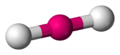 Linear 3D model
 -
 Bent 3D model
 -
 Bent 3D model
 -
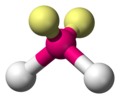 Bent 3D model
 -
Bent 3D model
-
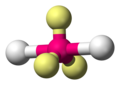 Linear 3D model
 -
Linear 3D model
-
 Trigonal planar 3D model
 -
 Trigonal planar 3D model
 -
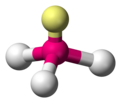 Trigonal pyramidal 3D model
 -
 Trigonal pyramidal 3D model
 -
 T-shaped 3D model
 -
 T-shaped 3D model
 -
 Tetrahedral 3D model
 -
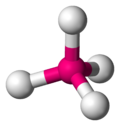 Tetrahedral 3D model
 -
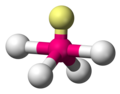 Seesaw 3D model
 -
 Seesaw 3D model
 -
 Square planar 3D model
 -
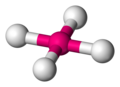 Square planar 3D model
 -
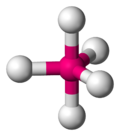 Trigonal bipyramidal 3D model
 -
Trigonal bipyramidal 3D model
-
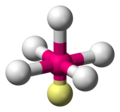 Square pyramidal 3D model
 -
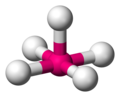 Square pyramidal 3D model
 -
 Pentagonal planar 3D model
 -
 Pentagonal planar 3D model
 -
 Octahedral 3D model
 -
 Octahedral 3D model
 -
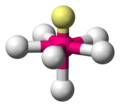 Pentagonal pyramidal 3D model
 -
 Pentagonal pyramidal 3D model
 -
 Pentagonal bipyramidal 3D model
 -
 Pentagonal bipyramidal 3D model
 -
 Square antiprismatic 3D model
 -
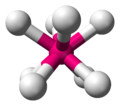 Square antiprismatic 3D model
 -
Linear 3D model
-
Trigonal 3D model
-
Tetrahedral 3D model
-
Trigonal bipyramidal 3D model
-
Square pyramidal 3D model
-
Octahedral 3D model
-
Pentagonal bipyramidal 3D model
-
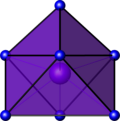 Face-capped octahedron
 -
 Monocapped trigonal prism
 -
Square antiprismatic 3D model
-
 Snub disphenoid
 -
 Square face bicapped trigonal prism
 -
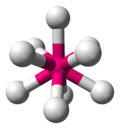 3D model
 -
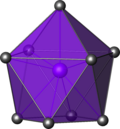 Monocapped square antiprism
 -
 Xenon hexafluoride
 -
 Hexamethyl tungsten
 -
Bent 3D model
-
Pyramidal 3D model
-
Tetrahedral 3D model
-
Square pyramidal 3D model
-
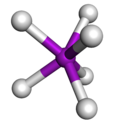 Prismatic trigonal prism


VSEPR_theory
-
VSEPR_theory
-
VSEPR_theory
-
VSEPR_theory
-
VSEPR_theory
-
VSEPR_theory
-
VSEPR_theory
-
VSEPR_theory
-
VSEPR_theory
-
VSEPR_theory
-
VSEPR_theory
-
VSEPR_theory
-
VSEPR_theory
VSEPR_theory
-
VSEPR_theory
-
VSEPR_theory
-
VSEPR_theory
-
VSEPR_theory
-
VSEPR_theory
-
VSEPR_theory
-
VSEPR_theory
-
VSEPR_theory
-
VSEPR_theory
-
VSEPR_theory
-
VSEPR_theory
-
VSEPR_theory
Medical Disclaimer: WikiMD is for informational purposes only and is not a substitute for professional medical advice. Content may be inaccurate or outdated and should not be used for diagnosis or treatment. Always consult your healthcare provider for medical decisions. Verify information with trusted sources such as CDC.gov and NIH.gov. By using this site, you agree that WikiMD is not liable for any outcomes related to its content. See full disclaimer.
Credits:Most images are courtesy of Wikimedia commons, and templates, categories Wikipedia, licensed under CC BY SA or similar.
Translate this page: - East Asian
中文,
日本,
한국어,
South Asian
हिन्दी,
தமிழ்,
తెలుగు,
Urdu,
ಕನ್ನಡ,
Southeast Asian
Indonesian,
Vietnamese,
Thai,
မြန်မာဘာသာ,
বাংলা
European
español,
Deutsch,
français,
Greek,
português do Brasil,
polski,
română,
русский,
Nederlands,
norsk,
svenska,
suomi,
Italian
Middle Eastern & African
عربى,
Turkish,
Persian,
Hebrew,
Afrikaans,
isiZulu,
Kiswahili,
Other
Bulgarian,
Hungarian,
Czech,
Swedish,
മലയാളം,
मराठी,
ਪੰਜਾਬੀ,
ગુજરાતી,
Portuguese,
Ukrainian
