Tarring and feathering
,_The_Bostonians_Paying_the_Excise-man,_or_Tarring_and_Feathering_(1774)_-_02.jpg)


Tarring and Feathering was a form of public humiliation and punishment used to enforce unofficial justice or revenge. It was never legally sanctioned by any government but was practiced by informal groups. The process involved covering an individual with hot tar followed by feathers. This act was often carried out by vigilante groups to punish or intimidate individuals who were seen as wrongdoers or outsiders within a community.
History
The origins of tarring and feathering are difficult to trace, but the practice was used in medieval Europe and became more common in the 18th century, particularly in Britain and the American colonies. It was often associated with the American Revolution, where it was used by both Patriots and Loyalists as a form of mob justice against those who opposed their political views.
Procedure
The procedure of tarring and feathering could vary, but it typically involved heating tar until it was liquified. The tar was then applied to the naked body of the victim, either with a brush or by pouring it directly onto them. After the tar was applied, feathers were thrown onto the sticky substance, adhering to the body. The tar used was generally pine tar, a substance more commonly used for waterproofing ropes and ships. It was not as hot as modern industrial tar and was unlikely to cause serious burns, but the process was still extremely painful and humiliating.
Social and Political Implications
Tarring and feathering was more than just a physical punishment; it served as a powerful tool of social ostracism. Victims were often paraded through the streets, further enhancing the public humiliation. The act was a clear message from the community or group performing the punishment, indicating that the victim's actions or presence was not tolerated. It was used against tax collectors, political figures, and others who were seen as betraying community interests.
Decline
The practice began to decline in the 19th century as societies moved towards more formalized systems of justice. However, isolated incidents of tarring and feathering were reported into the early 20th century, particularly in rural areas.
In Popular Culture
Tarring and feathering has been depicted in various works of literature and film, often to highlight the brutality of mob justice or the plight of individuals facing community ostracism.
Legal and Ethical Considerations
From a modern perspective, tarring and feathering is considered a form of cruel and unusual punishment. It violates principles of human rights and dignity and would be illegal under current laws in most jurisdictions.
Gallery
-
 John Meintz, punished during World War I
 -
 John Meintz, punished during World War I
 -
 Huck Finn Travelling by Rail
 -
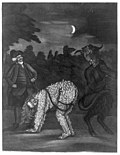 A tarred and feathered man standing on hands and feet
 -
 Mother's Angel (1920)


_-_1.jpg)

See Also
External Links
- History of Tarring and Feathering - History.com
Ad. Transform your health with W8MD Weight Loss, Sleep & MedSpa

Tired of being overweight?
Get started with evidence based, physician-supervised
affordable GLP-1 weight loss injections
Now available in New York City and Philadelphia:
- Semaglutide starting from $59.99/week and up
- Tirzepatide starting from $69.99/week and up (dose dependent)
✔ Evidence-based medical weight loss ✔ Insurance-friendly visits available ✔ Same-week appointments, evenings & weekends
Learn more:
Start your transformation today with W8MD weight loss centers.
|
WikiMD Medical Encyclopedia |
Medical Disclaimer: WikiMD is for informational purposes only and is not a substitute for professional medical advice. Content may be inaccurate or outdated and should not be used for diagnosis or treatment. Always consult your healthcare provider for medical decisions. Verify information with trusted sources such as CDC.gov and NIH.gov. By using this site, you agree that WikiMD is not liable for any outcomes related to its content. See full disclaimer.
Credits:Most images are courtesy of Wikimedia commons, and templates, categories Wikipedia, licensed under CC BY SA or similar.
Translate this page: - East Asian
中文,
日本,
한국어,
South Asian
हिन्दी,
தமிழ்,
తెలుగు,
Urdu,
ಕನ್ನಡ,
Southeast Asian
Indonesian,
Vietnamese,
Thai,
မြန်မာဘာသာ,
বাংলা
European
español,
Deutsch,
français,
Greek,
português do Brasil,
polski,
română,
русский,
Nederlands,
norsk,
svenska,
suomi,
Italian
Middle Eastern & African
عربى,
Turkish,
Persian,
Hebrew,
Afrikaans,
isiZulu,
Kiswahili,
Other
Bulgarian,
Hungarian,
Czech,
Swedish,
മലയാളം,
मराठी,
ਪੰਜਾਬੀ,
ગુજરાતી,
Portuguese,
Ukrainian
