Osmia lignaria
Osmia lignaria, commonly known as the blue orchard bee or BOB, is a species of mason bee native to North America. This solitary bee is an important pollinator in many ecosystems, particularly in orchards and gardens. Unlike honeybees, Osmia lignaria does not live in hives but nests in small cavities, often in wood. Due to its efficient pollination of fruit trees, it is increasingly used in commercial agriculture as an alternative to the European honeybee.
Description
Osmia lignaria individuals are medium-sized bees, with females typically larger than males. The females have a metallic blue-green hue, while males are slightly smaller with more of a dusky coloration. Both sexes have robust bodies covered in dense hairs that facilitate pollen collection.
Habitat and Distribution
Originally found throughout North America, from Canada to Mexico, Osmia lignaria prefers woodland edges, gardens, and orchards. They are adaptable and can nest in pre-existing cavities like hollow stems, wood holes created by wood-boring insects, or even artificial nesting sites provided by beekeepers.
Life Cycle
The life cycle of Osmia lignaria begins in spring when temperatures rise above 14°C (57°F), prompting the adult bees to emerge from their nests. After mating, females collect pollen and nectar to create a provision mass in a suitable cavity. On this mass, she lays an egg before sealing off the chamber with a mud partition. This process is repeated until the female has filled the cavity. Larvae hatch from the eggs, consume the provision mass, and then pupate, emerging as adults the following spring.
Pollination
Osmia lignaria is particularly effective at pollinating early spring flowers, including fruit trees such as apple, pear, and cherry. Their foraging behavior and body size make them more efficient pollinators for some crops compared to the European honeybee. As solitary bees, they are less prone to disease spread, making them a valuable asset in sustainable agriculture practices.
Conservation
While not currently listed as endangered, Osmia lignaria faces threats from habitat loss, pesticide exposure, and competition from non-native bee species. Conservation efforts focus on providing nesting habitats and reducing pesticide usage in areas where these bees are active.
In Agriculture
Due to their pollination efficiency, Osmia lignaria is increasingly used in commercial fruit production. Farmers and orchardists can encourage their presence by providing artificial nesting sites and reducing pesticide use, especially during the blooming period of crops.
See Also

Osmia_lignaria
-
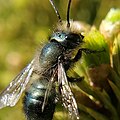 Blue Orchard Bee
 -
Osmia lignaria female
-
 Solitary bee house
 -
 Osmia lignaria
 -
 Mason bee nesting rolls


Ad. Transform your life with W8MD's Budget GLP-1 injections from $75


W8MD offers a medical weight loss program to lose weight in Philadelphia. Our physician-supervised medical weight loss provides:
- Weight loss injections in NYC (generic and brand names):
- Zepbound / Mounjaro, Wegovy / Ozempic, Saxenda
- Most insurances accepted or discounted self-pay rates. We will obtain insurance prior authorizations if needed.
- Generic GLP1 weight loss injections from $75 for the starting dose.
- Also offer prescription weight loss medications including Phentermine, Qsymia, Diethylpropion, Contrave etc.
NYC weight loss doctor appointmentsNYC weight loss doctor appointments
Start your NYC weight loss journey today at our NYC medical weight loss and Philadelphia medical weight loss clinics.
- Call 718-946-5500 to lose weight in NYC or for medical weight loss in Philadelphia 215-676-2334.
- Tags:NYC medical weight loss, Philadelphia lose weight Zepbound NYC, Budget GLP1 weight loss injections, Wegovy Philadelphia, Wegovy NYC, Philadelphia medical weight loss, Brookly weight loss and Wegovy NYC


|
WikiMD's Wellness Encyclopedia |
| Let Food Be Thy Medicine Medicine Thy Food - Hippocrates |
Medical Disclaimer: WikiMD is not a substitute for professional medical advice. The information on WikiMD is provided as an information resource only, may be incorrect, outdated or misleading, and is not to be used or relied on for any diagnostic or treatment purposes. Please consult your health care provider before making any healthcare decisions or for guidance about a specific medical condition. WikiMD expressly disclaims responsibility, and shall have no liability, for any damages, loss, injury, or liability whatsoever suffered as a result of your reliance on the information contained in this site. By visiting this site you agree to the foregoing terms and conditions, which may from time to time be changed or supplemented by WikiMD. If you do not agree to the foregoing terms and conditions, you should not enter or use this site. See full disclaimer.
Credits:Most images are courtesy of Wikimedia commons, and templates, categories Wikipedia, licensed under CC BY SA or similar.
Translate this page: - East Asian
中文,
日本,
한국어,
South Asian
हिन्दी,
தமிழ்,
తెలుగు,
Urdu,
ಕನ್ನಡ,
Southeast Asian
Indonesian,
Vietnamese,
Thai,
မြန်မာဘာသာ,
বাংলা
European
español,
Deutsch,
français,
Greek,
português do Brasil,
polski,
română,
русский,
Nederlands,
norsk,
svenska,
suomi,
Italian
Middle Eastern & African
عربى,
Turkish,
Persian,
Hebrew,
Afrikaans,
isiZulu,
Kiswahili,
Other
Bulgarian,
Hungarian,
Czech,
Swedish,
മലയാളം,
मराठी,
ਪੰਜਾਬੀ,
ગુજરાતી,
Portuguese,
Ukrainian

