Pulmonary alveolus
Pulmonary alveolus is a tiny air sac found in the lung parenchyma where gas exchange occurs. Pulmonary alveoli are the terminal ends of the respiratory tree and are organized into lobules, each containing a respiratory bronchiole, alveolar ducts, alveolar sacs, and alveoli.
Structure
Pulmonary alveoli are found in the acini at the beginning of the respiratory zone. They are located sparsely in the respiratory bronchioles, line the walls of the alveolar ducts, and are more numerous in the blind-ended alveolar sacs. The acini are the basic units of respiration, with gas exchange taking place in all the alveoli present.
Function
The main function of the pulmonary alveoli is to permit the exchange of gases between the air in the lungs and the blood in the capillaries. This process occurs by diffusion.
Clinical significance
Damage to the alveoli can result in a variety of lung diseases, including emphysema, pneumonia, and lung cancer.
See also
References
<references />
 | |
|---|---|
 |
 |
-
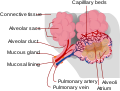 Diagram of an alveolus
 -
 Bronchial anatomy with description
 -
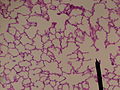 Alveolar sac
 -
 Annotated diagram of an alveolus
 -
 Cross section of an alveolus and capillaries showing diffusion of gases
 -
 Gas exchange in the alveolus
 -
 Cryptococcosis of lung in patient with AIDS
 -
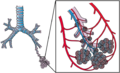 Pulmonary blood circulation
 -
 Pulmonary alveolus


_(14577681128).jpg)
Ad. Transform your health with W8MD Weight Loss, Sleep & MedSpa

Tired of being overweight?
Special offer:
Budget GLP-1 weight loss medications
- Semaglutide starting from $29.99/week and up with insurance for visit of $59.99 and up per week self pay.
- Tirzepatide starting from $45.00/week and up (dose dependent) or $69.99/week and up self pay
✔ Same-week appointments, evenings & weekends
Learn more:
- GLP-1 weight loss clinic NYC
- W8MD's NYC medical weight loss
- W8MD Philadelphia GLP-1 shots
- Philadelphia GLP-1 injections
- Affordable GLP-1 shots NYC
|
WikiMD Medical Encyclopedia |
Medical Disclaimer: WikiMD is for informational purposes only and is not a substitute for professional medical advice. Content may be inaccurate or outdated and should not be used for diagnosis or treatment. Always consult your healthcare provider for medical decisions. Verify information with trusted sources such as CDC.gov and NIH.gov. By using this site, you agree that WikiMD is not liable for any outcomes related to its content. See full disclaimer.
Credits:Most images are courtesy of Wikimedia commons, and templates, categories Wikipedia, licensed under CC BY SA or similar.
Translate this page: - East Asian
中文,
日本,
한국어,
South Asian
हिन्दी,
தமிழ்,
తెలుగు,
Urdu,
ಕನ್ನಡ,
Southeast Asian
Indonesian,
Vietnamese,
Thai,
မြန်မာဘာသာ,
বাংলা
European
español,
Deutsch,
français,
Greek,
português do Brasil,
polski,
română,
русский,
Nederlands,
norsk,
svenska,
suomi,
Italian
Middle Eastern & African
عربى,
Turkish,
Persian,
Hebrew,
Afrikaans,
isiZulu,
Kiswahili,
Other
Bulgarian,
Hungarian,
Czech,
Swedish,
മലയാളം,
मराठी,
ਪੰਜਾਬੀ,
ગુજરાતી,
Portuguese,
Ukrainian
