Sarah
Sarah is a common female given name of Hebrew origin. It is found in many cultures and languages around the world. The name is derived from the Hebrew word "שָׂרָה" (Sarai), which means "lady," "princess," or "noblewoman." In the Hebrew Bible, Sarah was the wife of Abraham and the mother of Isaac. Her story is significant in the religious traditions of Judaism, Christianity, and Islam, making her a pivotal figure in the shared history and theology of these Abrahamic faiths.
Etymology
The name Sarah signifies a woman of high rank and is often translated as "princess" or "noblewoman." The transition from Sarai (שָׂרָי) to Sarah (שָׂרָה) in biblical narratives symbolizes her important role and the divine promise of progeny and blessing.
Biblical Account
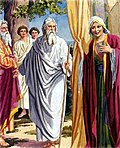
According to the Book of Genesis in the Bible, Sarah was originally named Sarai but had her name changed by God to Sarah as a part of a covenant. This change marked God's promise that she would be a mother of nations and kings of peoples would come from her. Despite her initial disbelief due to her old age, Sarah gave birth to Isaac, fulfilling God's promise.
Cultural Significance
Sarah's legacy extends beyond religious texts, influencing various aspects of culture, art, and literature. She is often depicted in paintings, sculptures, and writings that explore themes of faith, motherhood, and the power of divine intervention. Her story has been interpreted in numerous ways across different cultures and epochs, reflecting the universal appeal of her narrative.
In Modern Times
Today, the name Sarah remains popular in many countries. It is celebrated for its classic simplicity and deep historical roots. Many parents choose the name for its association with grace, nobility, and the pioneering spirit of the biblical figure.
Images
-
 Sarah
Sarah -
 Sarah
Sarah -
 Sarah
Sarah -
 Sarah
Sarah -
 Sarah
Sarah -
 Sarah
Sarah -
 Sarah
Sarah -
 Sarah
Sarah
.jpg)


See Also
| This article is a stub. You can help WikiMD by registering to expand it. |
Ad. Transform your life with W8MD's
GLP-1 weight loss injections special from $29.99 with insurance
|
WikiMD Medical Encyclopedia |
Medical Disclaimer: WikiMD is for informational purposes only and is not a substitute for professional medical advice. Content may be inaccurate or outdated and should not be used for diagnosis or treatment. Always consult your healthcare provider for medical decisions. Verify information with trusted sources such as CDC.gov and NIH.gov. By using this site, you agree that WikiMD is not liable for any outcomes related to its content. See full disclaimer.
Credits:Most images are courtesy of Wikimedia commons, and templates, categories Wikipedia, licensed under CC BY SA or similar.
Translate this page: - East Asian
中文,
日本,
한국어,
South Asian
हिन्दी,
தமிழ்,
తెలుగు,
Urdu,
ಕನ್ನಡ,
Southeast Asian
Indonesian,
Vietnamese,
Thai,
မြန်မာဘာသာ,
বাংলা
European
español,
Deutsch,
français,
Greek,
português do Brasil,
polski,
română,
русский,
Nederlands,
norsk,
svenska,
suomi,
Italian
Middle Eastern & African
عربى,
Turkish,
Persian,
Hebrew,
Afrikaans,
isiZulu,
Kiswahili,
Other
Bulgarian,
Hungarian,
Czech,
Swedish,
മലയാളം,
मराठी,
ਪੰਜਾਬੀ,
ગુજરાતી,
Portuguese,
Ukrainian
