Armillaria tabescens
-
 Armillaria tabescens
 -
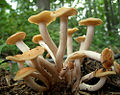 Armillaria tabescens


Armillaria tabescens
Armillaria tabescens, commonly known as the ringless honey mushroom, is a species of fungus in the family Physalacriaceae. It is a pathogenic fungus that primarily affects woody plants, causing a disease known as Armillaria root rot.
Description
Armillaria tabescens is characterized by its lack of an annulus, or ring, on the stipe, which distinguishes it from other species in the genus Armillaria. The cap is typically 3–10 cm in diameter, convex to flat, and varies in color from tan to brown. The gills are white to cream-colored and are attached to the stipe. The stipe itself is 5–15 cm long and 0.5–2 cm thick, often tapering towards the base.
Habitat and Distribution
Armillaria tabescens is found in temperate regions, particularly in North America, Europe, and parts of Asia. It grows in clusters on the ground, often near decaying wood or on the roots of living trees. This species is most commonly found in forests and woodlands, but it can also appear in urban and suburban areas where suitable hosts are present.
Life Cycle and Ecology
The life cycle of Armillaria tabescens involves both sexual and asexual stages. The fungus produces basidiospores on its gills, which are dispersed by the wind. These spores germinate to form mycelium, which can infect the roots of susceptible plants. The mycelium can spread through the soil, infecting other nearby plants.
Armillaria tabescens is a saprotroph and a necrotroph, meaning it can decompose dead organic matter and also infect living plants, causing disease. It is known to cause significant damage to forests and horticultural crops by killing trees and shrubs.
Symptoms and Management
Infected plants exhibit symptoms such as wilting, leaf chlorosis, and dieback. The presence of white mycelial fans under the bark and rhizomorphs in the soil are indicative of Armillaria infection. Management of Armillaria tabescens involves cultural practices such as removing infected stumps and roots, improving soil drainage, and selecting resistant plant species.
Related Pages
Ad. Transform your health with W8MD Weight Loss, Sleep & MedSpa

Tired of being overweight?
Get started with evidence based, physician-supervised
affordable GLP-1 weight loss injections
Now available in New York City and Philadelphia:
- Semaglutide starting from $59.99/week and up
- Tirzepatide starting from $69.99/week and up (dose dependent)
✔ Evidence-based medical weight loss ✔ Insurance-friendly visits available ✔ Same-week appointments, evenings & weekends
Learn more:
Start your transformation today with W8MD weight loss centers.
|
WikiMD Medical Encyclopedia |
Medical Disclaimer: WikiMD is for informational purposes only and is not a substitute for professional medical advice. Content may be inaccurate or outdated and should not be used for diagnosis or treatment. Always consult your healthcare provider for medical decisions. Verify information with trusted sources such as CDC.gov and NIH.gov. By using this site, you agree that WikiMD is not liable for any outcomes related to its content. See full disclaimer.
Credits:Most images are courtesy of Wikimedia commons, and templates, categories Wikipedia, licensed under CC BY SA or similar.
Translate this page: - East Asian
中文,
日本,
한국어,
South Asian
हिन्दी,
தமிழ்,
తెలుగు,
Urdu,
ಕನ್ನಡ,
Southeast Asian
Indonesian,
Vietnamese,
Thai,
မြန်မာဘာသာ,
বাংলা
European
español,
Deutsch,
français,
Greek,
português do Brasil,
polski,
română,
русский,
Nederlands,
norsk,
svenska,
suomi,
Italian
Middle Eastern & African
عربى,
Turkish,
Persian,
Hebrew,
Afrikaans,
isiZulu,
Kiswahili,
Other
Bulgarian,
Hungarian,
Czech,
Swedish,
മലയാളം,
मराठी,
ਪੰਜਾਬੀ,
ગુજરાતી,
Portuguese,
Ukrainian
