Bullous impetigo
Bullous Impetigo is a highly contagious bacterial skin infection primarily affecting infants and young children. It is characterized by the presence of large, fluid-filled blisters (bullae) that can rupture and form a yellowish crust. This condition is caused by a toxin-producing strain of Staphylococcus aureus and, less commonly, by Streptococcus pyogenes.
Causes and Transmission
Bullous impetigo is mainly caused by exfoliative toxins produced by certain strains of Staphylococcus aureus. These toxins target desmoglein-1, a protein essential for the adhesion between cells in the epidermis, leading to the characteristic blistering of the skin. Transmission occurs through direct contact with infected individuals or with contaminated objects. The high contagiousness of bullous impetigo makes outbreaks common in crowded environments, such as schools and daycare centers.
Symptoms
The hallmark symptom of bullous impetigo is the formation of large, fluid-filled blisters on the skin. These blisters are typically painless but can be accompanied by itching. Common sites of infection include the trunk, arms, and legs. The blisters eventually rupture, leaving behind a thin, brown crust. In some cases, affected individuals may also experience fever and lymphadenopathy (swollen lymph nodes).
Diagnosis
Diagnosis of bullous impetigo is primarily based on clinical presentation. In uncertain cases, a bacterial culture or polymerase chain reaction (PCR) test may be performed to identify the causative organism. Differential diagnosis includes other blistering skin conditions, such as Dermatitis Herpetiformis and Pemphigus Vulgaris.
Treatment
The treatment of bullous impetigo involves the use of systemic antibiotics to eradicate the infection. Mupirocin ointment may also be applied to the affected areas. It is important to maintain good hygiene and avoid sharing personal items to prevent the spread of the infection.
Prevention
Preventive measures include practicing good personal hygiene, keeping wounds clean and covered, and avoiding close contact with individuals who have the infection. In settings where bullous impetigo is prevalent, such as schools and daycare centers, prompt identification and treatment of affected individuals can help limit outbreaks.
Complications
If left untreated, bullous impetigo can lead to complications such as cellulitis, a deeper skin infection, and post-streptococcal glomerulonephritis, a kidney disease that can occur after a streptococcal infection. However, with appropriate treatment, the prognosis for bullous impetigo is excellent.


-
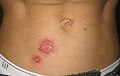 Bullous impetigo on the arm
 -
 Close-up of bullous impetigo lesions
 -
 Bullous impetigo on the face

Ad. Transform your health with W8MD Weight Loss, Sleep & MedSpa

Tired of being overweight?
Get started with evidence based, physician-supervised
affordable GLP-1 weight loss injections
Now available in New York City and Philadelphia:
- Semaglutide starting from $59.99/week and up
- Tirzepatide starting from $69.99/week and up (dose dependent)
✔ Evidence-based medical weight loss ✔ Insurance-friendly visits available ✔ Same-week appointments, evenings & weekends
Learn more:
Start your transformation today with W8MD weight loss centers.
|
WikiMD Medical Encyclopedia |
Medical Disclaimer: WikiMD is for informational purposes only and is not a substitute for professional medical advice. Content may be inaccurate or outdated and should not be used for diagnosis or treatment. Always consult your healthcare provider for medical decisions. Verify information with trusted sources such as CDC.gov and NIH.gov. By using this site, you agree that WikiMD is not liable for any outcomes related to its content. See full disclaimer.
Credits:Most images are courtesy of Wikimedia commons, and templates, categories Wikipedia, licensed under CC BY SA or similar.
Translate this page: - East Asian
中文,
日本,
한국어,
South Asian
हिन्दी,
தமிழ்,
తెలుగు,
Urdu,
ಕನ್ನಡ,
Southeast Asian
Indonesian,
Vietnamese,
Thai,
မြန်မာဘာသာ,
বাংলা
European
español,
Deutsch,
français,
Greek,
português do Brasil,
polski,
română,
русский,
Nederlands,
norsk,
svenska,
suomi,
Italian
Middle Eastern & African
عربى,
Turkish,
Persian,
Hebrew,
Afrikaans,
isiZulu,
Kiswahili,
Other
Bulgarian,
Hungarian,
Czech,
Swedish,
മലയാളം,
मराठी,
ਪੰਜਾਬੀ,
ગુજરાતી,
Portuguese,
Ukrainian
