Nitrifying bacteria
Overview

Nitrifying bacteria are a diverse group of microorganisms that play a crucial role in the nitrogen cycle by converting ammonia into nitrate. This process is essential for maintaining the balance of nitrogen in the environment and is critical for soil fertility and aquatic ecosystems.
Types of Nitrifying Bacteria
Nitrifying bacteria are primarily divided into two groups based on the specific chemical transformation they perform:
Ammonia-oxidizing bacteria (AOB)
Ammonia-oxidizing bacteria are responsible for the first step of nitrification, which is the oxidation of ammonia (NH_) to nitrite (NO__). This process is known as ammonia oxidation. The most well-known genera of AOB include Nitrosomonas and Nitrosococcus.
Nitrite-oxidizing bacteria (NOB)
Nitrite-oxidizing bacteria carry out the second step of nitrification, converting nitrite (NO__) into nitrate (NO__). Common genera of NOB include Nitrobacter and Nitrospira.
Metabolic Processes
Nitrifying bacteria are chemolithoautotrophs, meaning they obtain energy by oxidizing inorganic compounds and use carbon dioxide as their carbon source. The energy derived from the oxidation of ammonia or nitrite is used to fix carbon dioxide into organic compounds.
Ammonia Oxidation
The process of ammonia oxidation involves the enzyme ammonia monooxygenase, which catalyzes the conversion of ammonia to hydroxylamine, followed by further oxidation to nitrite by hydroxylamine oxidoreductase.
Nitrite Oxidation
Nitrite oxidation is catalyzed by the enzyme nitrite oxidoreductase, which converts nitrite to nitrate, completing the nitrification process.
Environmental Importance
Nitrifying bacteria are essential for the biogeochemical cycling of nitrogen. They help in the removal of excess ammonia from the environment, which can be toxic to plants and animals. In wastewater treatment plants, nitrifying bacteria are used to reduce ammonia levels in effluent before it is released into natural water bodies.
Challenges and Considerations
Nitrifying bacteria are sensitive to environmental conditions such as pH, temperature, and the presence of inhibitors like heavy metals and organic compounds. Maintaining optimal conditions is crucial for their activity in both natural and engineered systems.
Related Pages
-
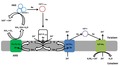 Ammonia oxidation
Ad. Transform your life with W8MD's
GLP-1 weight loss injections special from $29.99 with insurance
|
WikiMD Medical Encyclopedia |
Medical Disclaimer: WikiMD is for informational purposes only and is not a substitute for professional medical advice. Content may be inaccurate or outdated and should not be used for diagnosis or treatment. Always consult your healthcare provider for medical decisions. Verify information with trusted sources such as CDC.gov and NIH.gov. By using this site, you agree that WikiMD is not liable for any outcomes related to its content. See full disclaimer.
Credits:Most images are courtesy of Wikimedia commons, and templates, categories Wikipedia, licensed under CC BY SA or similar.
Translate this page: - East Asian
中文,
日本,
한국어,
South Asian
हिन्दी,
தமிழ்,
తెలుగు,
Urdu,
ಕನ್ನಡ,
Southeast Asian
Indonesian,
Vietnamese,
Thai,
မြန်မာဘာသာ,
বাংলা
European
español,
Deutsch,
français,
Greek,
português do Brasil,
polski,
română,
русский,
Nederlands,
norsk,
svenska,
suomi,
Italian
Middle Eastern & African
عربى,
Turkish,
Persian,
Hebrew,
Afrikaans,
isiZulu,
Kiswahili,
Other
Bulgarian,
Hungarian,
Czech,
Swedish,
മലയാളം,
मराठी,
ਪੰਜਾਬੀ,
ગુજરાતી,
Portuguese,
Ukrainian
