Ventricular escape beat
Ventricular Escape Beat
A ventricular escape beat is a type of heart rhythm disturbance that occurs when the heart's normal pacemaker, the sinoatrial node, fails to initiate an impulse. This results in a backup pacemaker, typically located in the ventricles, taking over to maintain the heart's rhythm. Ventricular escape beats are a protective mechanism to prevent the heart from stopping entirely when the primary pacemaker fails.
Mechanism
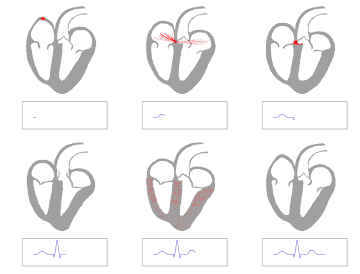
Under normal circumstances, the sinoatrial node generates electrical impulses that travel through the heart, causing it to contract and pump blood. However, if the sinoatrial node fails to produce an impulse, or if the impulse is blocked, the heart's atrioventricular node or the ventricles themselves can generate an impulse. This impulse is known as a ventricular escape beat. The ventricles have an intrinsic rate of 20-40 beats per minute, which is slower than the normal heart rate.
Electrocardiogram (ECG) Characteristics
On an electrocardiogram (ECG), a ventricular escape beat is characterized by a wide and bizarre QRS complex, as the impulse originates in the ventricles rather than following the normal conduction pathway. The QRS complex is typically greater than 120 milliseconds. The absence of a preceding P wave is another distinguishing feature, as the impulse does not originate from the atria.

Clinical Significance
Ventricular escape beats are generally considered benign and are often seen in cases of bradycardia, where the heart rate is slower than normal. They can occur in healthy individuals, particularly during sleep, or in response to increased vagal tone. However, frequent ventricular escape beats may indicate underlying heart disease or electrolyte imbalances and warrant further investigation.
Management
In most cases, ventricular escape beats do not require treatment. However, if they are symptomatic or associated with significant bradycardia, treatment may involve addressing the underlying cause, such as correcting electrolyte imbalances or adjusting medications. In some cases, a pacemaker may be necessary to maintain an adequate heart rate.
Related Pages
References
- Goldberger, Ary L. "Clinical Electrocardiography: A Simplified Approach." Elsevier Health Sciences, 2017.
- Surawicz, Borys, and Timothy Knilans. "Chou's Electrocardiography in Clinical Practice: Adult and Pediatric." Elsevier Health Sciences, 2008.

-
 Ventricular escape beat
 -
 Ventricular escape beat
Ad. Transform your life with W8MD's
GLP-1 weight loss injections special from $29.99 with insurance
|
WikiMD Medical Encyclopedia |
Medical Disclaimer: WikiMD is for informational purposes only and is not a substitute for professional medical advice. Content may be inaccurate or outdated and should not be used for diagnosis or treatment. Always consult your healthcare provider for medical decisions. Verify information with trusted sources such as CDC.gov and NIH.gov. By using this site, you agree that WikiMD is not liable for any outcomes related to its content. See full disclaimer.
Credits:Most images are courtesy of Wikimedia commons, and templates, categories Wikipedia, licensed under CC BY SA or similar.
Translate this page: - East Asian
中文,
日本,
한국어,
South Asian
हिन्दी,
தமிழ்,
తెలుగు,
Urdu,
ಕನ್ನಡ,
Southeast Asian
Indonesian,
Vietnamese,
Thai,
မြန်မာဘာသာ,
বাংলা
European
español,
Deutsch,
français,
Greek,
português do Brasil,
polski,
română,
русский,
Nederlands,
norsk,
svenska,
suomi,
Italian
Middle Eastern & African
عربى,
Turkish,
Persian,
Hebrew,
Afrikaans,
isiZulu,
Kiswahili,
Other
Bulgarian,
Hungarian,
Czech,
Swedish,
മലയാളം,
मराठी,
ਪੰਜਾਬੀ,
ગુજરાતી,
Portuguese,
Ukrainian
