Industrial robot
Industrial robots are automated, programmable machines designed to carry out a variety of tasks in manufacturing and production settings. They are a pivotal component of modern industrial automation, enhancing efficiency, precision, and safety in the workplace. Industrial robots can perform tasks such as welding, painting, assembly, pick and place, product inspection, and testing. They are characterized by their ability to be programmed to execute complex tasks, their durability, and their capacity to work in environments that may be hazardous to humans.
History
The concept of industrial robots has evolved significantly since the first robotic arm, Unimate, was introduced in the 1960s. Unimate was the first of its kind to work on a General Motors assembly line, handling hot pieces of metal. This marked the beginning of a new era in industrial manufacturing, leading to the development of more sophisticated and versatile robotic systems.
Types of Industrial Robots
There are several types of industrial robots, each designed for specific tasks and applications. The most common types include:
- Articulated Robots: Characterized by their arm-like structure, articulated robots have multiple rotary joints that allow for a wide range of motion. They are commonly used in assembly, welding, and material handling.
- SCARA Robots: Selective Compliance Assembly Robot Arm (SCARA) robots are designed for high-speed assembly tasks. They have a limited range of motion compared to articulated robots but are highly precise in their movements.
- Delta Robots: Known for their spider-like structure, delta robots are used in picking and packing applications. They are extremely fast and capable of handling delicate products.
- Cartesian Robots: These robots move along straight lines and are used for tasks that require high precision, such as CNC machining and 3D printing.
- Collaborative Robots (Cobots): Cobots are designed to work alongside human workers, assisting with a variety of tasks while ensuring safety through advanced sensors and software.
Applications
Industrial robots are utilized in a wide range of industries, including automotive, electronics, food and beverage, pharmaceuticals, and more. Their applications include, but are not limited to:
- Welding: Robots provide precision and consistency in welding tasks, reducing errors and improving safety.
- Painting: Robots can apply paint with high precision and consistency, improving the quality of the finish and reducing waste.
- Assembly: Robots can perform repetitive assembly tasks with high speed and accuracy, increasing production efficiency.
- Material Handling: Robots can move heavy and bulky materials, reducing the risk of injury to human workers.
- Inspection and Testing: Robots equipped with vision systems can inspect and test products with high accuracy, ensuring quality control.
Advantages and Challenges
The adoption of industrial robots offers numerous advantages, including increased productivity, improved product quality, and enhanced worker safety. However, there are also challenges, such as the high initial investment, the need for skilled personnel to program and maintain the robots, and concerns about job displacement.
Future Trends
The future of industrial robots includes advancements in artificial intelligence (AI), machine learning, and robotics technology, leading to even more versatile and intelligent robots. The integration of AI will enable robots to learn from their environment and improve their performance over time. Additionally, the development of more sophisticated sensors and control systems will enhance the capabilities of robots to interact safely and effectively with human workers.

-
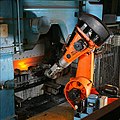 Automation of foundry with robot
 -
 FANUC 6-axis welding robots
 -
 Factory automation robotics palettizing bread
 -
 George C. Devol
 -
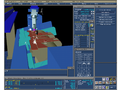 Offline teaching welding
 -
 Staubli teach pendant
 -
RoboLogix work envelope


Ad. Transform your health with W8MD Weight Loss, Sleep & MedSpa

Tired of being overweight?
Special offer:
Budget GLP-1 weight loss medications
- Semaglutide starting from $29.99/week and up with insurance for visit of $59.99 and up per week self pay.
- Tirzepatide starting from $45.00/week and up (dose dependent) or $69.99/week and up self pay
✔ Same-week appointments, evenings & weekends
Learn more:
- GLP-1 weight loss clinic NYC
- W8MD's NYC medical weight loss
- W8MD Philadelphia GLP-1 shots
- Philadelphia GLP-1 injections
- Affordable GLP-1 shots NYC
|
WikiMD Medical Encyclopedia |
Medical Disclaimer: WikiMD is for informational purposes only and is not a substitute for professional medical advice. Content may be inaccurate or outdated and should not be used for diagnosis or treatment. Always consult your healthcare provider for medical decisions. Verify information with trusted sources such as CDC.gov and NIH.gov. By using this site, you agree that WikiMD is not liable for any outcomes related to its content. See full disclaimer.
Credits:Most images are courtesy of Wikimedia commons, and templates, categories Wikipedia, licensed under CC BY SA or similar.
Translate this page: - East Asian
中文,
日本,
한국어,
South Asian
हिन्दी,
தமிழ்,
తెలుగు,
Urdu,
ಕನ್ನಡ,
Southeast Asian
Indonesian,
Vietnamese,
Thai,
မြန်မာဘာသာ,
বাংলা
European
español,
Deutsch,
français,
Greek,
português do Brasil,
polski,
română,
русский,
Nederlands,
norsk,
svenska,
suomi,
Italian
Middle Eastern & African
عربى,
Turkish,
Persian,
Hebrew,
Afrikaans,
isiZulu,
Kiswahili,
Other
Bulgarian,
Hungarian,
Czech,
Swedish,
മലയാളം,
मराठी,
ਪੰਜਾਬੀ,
ગુજરાતી,
Portuguese,
Ukrainian

