Bacterial taxonomy
Bacterial taxonomy is the taxonomy, i.e., the rank-based classification, of bacteria. In the scientific classification established by Carl Linnaeus, each species has to be assigned to a genus (binary nomenclature), which in turn is a lower level of a hierarchy of ranks (family, order, class, phylum, kingdom). The introduction of molecular methods of genetic analysis has led to a revolutionary understanding of bacterial taxonomy, and the relationships between bacterial species, which has significantly changed the classification systems.
History
The study of bacterial taxonomy has evolved significantly since its inception, initially based on the phenotypic characteristics of bacteria such as shape, staining properties, and metabolic activities. The work of scientists like Louis Pasteur and Robert Koch contributed to the early classification systems by identifying bacteria responsible for specific diseases. However, these early classifications were limited by the technology of the time.
The development of molecular techniques, especially DNA sequencing, has dramatically changed the landscape of bacterial taxonomy. The analysis of 16S ribosomal RNA sequences, a component of the 30S subunit of the prokaryotic ribosome, has become a fundamental tool in identifying and classifying bacteria since it provides a highly conserved sequence to compare different organisms.
Classification Systems
Bacterial taxonomy has several classification systems, the most widely recognized being the Bergey's Manual of Systematic Bacteriology. This manual divides bacteria into four major groups based on their physiology, morphology, and biochemical properties: the Gracilicutes (Gram-negative bacteria), the Firmicutes (Gram-positive bacteria), the Tenericutes (bacteria without a cell wall), and the Mendosicutes (archaebacteria).
Molecular Methods
Molecular methods have introduced a phylogenetic perspective to bacterial taxonomy, emphasizing the evolutionary relationships between different bacterial species. Techniques such as DNA-DNA hybridization, 16S rRNA gene sequencing, and whole-genome sequencing have become essential tools in identifying and classifying bacteria.
Current Challenges
Despite advancements, bacterial taxonomy faces several challenges. The discovery of horizontal gene transfer (HGT) among bacteria complicates the understanding of their evolutionary relationships since it can result in significant genetic changes that do not follow a vertical inheritance pattern. Additionally, the vast diversity of the bacterial world means that many species remain unclassified or undiscovered.
Importance
Understanding bacterial taxonomy is crucial for various aspects of science and medicine. It aids in the identification of pathogens, understanding microbial ecology, and developing antibiotics and other treatments. Moreover, it plays a vital role in biotechnology, agriculture, and environmental science by identifying beneficial bacteria that can be used in food production, biofuel generation, and bioremediation.
See Also

-
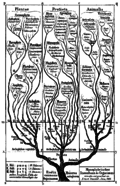 Haeckel tree

Ad. Transform your health with W8MD Weight Loss, Sleep & MedSpa

Tired of being overweight?
Special offer:
Budget GLP-1 weight loss medications
- Semaglutide starting from $29.99/week and up with insurance for visit of $59.99 and up per week self pay.
- Tirzepatide starting from $45.00/week and up (dose dependent) or $69.99/week and up self pay
✔ Same-week appointments, evenings & weekends
Learn more:
- GLP-1 weight loss clinic NYC
- W8MD's NYC medical weight loss
- W8MD Philadelphia GLP-1 shots
- Philadelphia GLP-1 injections
- Affordable GLP-1 shots NYC
|
WikiMD Medical Encyclopedia |
Medical Disclaimer: WikiMD is for informational purposes only and is not a substitute for professional medical advice. Content may be inaccurate or outdated and should not be used for diagnosis or treatment. Always consult your healthcare provider for medical decisions. Verify information with trusted sources such as CDC.gov and NIH.gov. By using this site, you agree that WikiMD is not liable for any outcomes related to its content. See full disclaimer.
Credits:Most images are courtesy of Wikimedia commons, and templates, categories Wikipedia, licensed under CC BY SA or similar.
Translate this page: - East Asian
中文,
日本,
한국어,
South Asian
हिन्दी,
தமிழ்,
తెలుగు,
Urdu,
ಕನ್ನಡ,
Southeast Asian
Indonesian,
Vietnamese,
Thai,
မြန်မာဘာသာ,
বাংলা
European
español,
Deutsch,
français,
Greek,
português do Brasil,
polski,
română,
русский,
Nederlands,
norsk,
svenska,
suomi,
Italian
Middle Eastern & African
عربى,
Turkish,
Persian,
Hebrew,
Afrikaans,
isiZulu,
Kiswahili,
Other
Bulgarian,
Hungarian,
Czech,
Swedish,
മലയാളം,
मराठी,
ਪੰਜਾਬੀ,
ગુજરાતી,
Portuguese,
Ukrainian
