Tissue microarray
Tissue Microarray (TMA) is a high-throughput technology used in pathology and cancer research for the analysis of multiple tissue samples simultaneously. It involves the extraction of tissue cores from various donor blocks and their re-arrangement into a new, single recipient block. This technique allows for the rapid visualization and assessment of molecular markers within a large number of tissue specimens, facilitating comparative studies across different tissue types or disease states.
Overview
The concept of TMA was developed to address the need for a more efficient way of conducting studies on tissue specimens. Traditional methods, which involve the examination of one slide at a time, are time-consuming and resource-intensive. TMA technology, on the other hand, enables researchers to analyze hundreds of tissue samples on a single slide. This not only conserves valuable tissue but also standardizes experimental conditions, improving the reliability of comparative analyses.
Construction
The construction of a TMA involves several key steps. First, donor tissue blocks and corresponding histological slides are reviewed to identify representative areas for sampling. Using a tissue arrayer, cylindrical cores (typically 0.6mm to 2mm in diameter) are punched from these selected areas of the donor blocks and inserted into a pre-drilled recipient block in a precisely organized array. Once constructed, the TMA block can be sectioned into thin slices using a microtome, and these sections are then transferred to slides for subsequent analysis.
Applications
TMA technology has a wide range of applications, particularly in the field of oncology. It is used for the validation of novel biomarkers, the study of cancer epidemiology, and the assessment of gene expression patterns. TMAs are also valuable in drug discovery and development, as they can be used to evaluate the efficacy of therapeutic agents across different tissue types or disease states. Furthermore, TMAs facilitate the study of tissue-specific expression of proteins, helping to elucidate the molecular mechanisms underlying various diseases.
Advantages and Limitations
One of the main advantages of TMA is its efficiency. By allowing for the simultaneous analysis of multiple samples, it significantly reduces the time and resources required for large-scale studies. Additionally, the use of standardized sections ensures that experimental conditions are consistent across all samples, enhancing the comparability of results.
However, TMA technology also has its limitations. The small size of the tissue cores may not be representative of the entire donor tissue block, potentially leading to sampling bias. Moreover, the quality of the TMA sections can be affected by the quality of the donor tissue and the precision of the array construction process.
Conclusion
Tissue Microarray is a powerful tool in the field of pathology and cancer research, offering a high-throughput method for the analysis of tissue specimens. Despite its limitations, the technology has significantly contributed to the advancement of molecular pathology, providing valuable insights into the molecular basis of diseases and facilitating the development of targeted therapies.

-
 Tissue MicroArray Block
 -
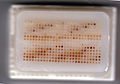 0.6 mm core Tissue MicroArray Block
 -
 Tissue MicroArray Slide


Ad. Transform your life with W8MD's
GLP-1 weight loss injections special from $29.99 with insurance
|
WikiMD Medical Encyclopedia |
Medical Disclaimer: WikiMD is for informational purposes only and is not a substitute for professional medical advice. Content may be inaccurate or outdated and should not be used for diagnosis or treatment. Always consult your healthcare provider for medical decisions. Verify information with trusted sources such as CDC.gov and NIH.gov. By using this site, you agree that WikiMD is not liable for any outcomes related to its content. See full disclaimer.
Credits:Most images are courtesy of Wikimedia commons, and templates, categories Wikipedia, licensed under CC BY SA or similar.
Translate this page: - East Asian
中文,
日本,
한국어,
South Asian
हिन्दी,
தமிழ்,
తెలుగు,
Urdu,
ಕನ್ನಡ,
Southeast Asian
Indonesian,
Vietnamese,
Thai,
မြန်မာဘာသာ,
বাংলা
European
español,
Deutsch,
français,
Greek,
português do Brasil,
polski,
română,
русский,
Nederlands,
norsk,
svenska,
suomi,
Italian
Middle Eastern & African
عربى,
Turkish,
Persian,
Hebrew,
Afrikaans,
isiZulu,
Kiswahili,
Other
Bulgarian,
Hungarian,
Czech,
Swedish,
മലയാളം,
मराठी,
ਪੰਜਾਬੀ,
ગુજરાતી,
Portuguese,
Ukrainian
