Volcanic ash
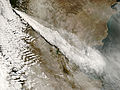
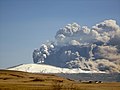
Volcanic ash refers to the fine particles of rock and volcanic glass created during volcanic eruptions. These particles are ejected into the atmosphere and can travel vast distances from the volcano. Volcanic ash poses significant hazards to health, aviation, and agriculture. It consists of tiny jagged pieces of rocks, minerals, and volcanic glass, the size of which is less than 2 millimeters in diameter.
Composition
Volcanic ash is primarily composed of silica (SiO2), with varying amounts of aluminum oxide (Al2O3), calcium oxide (CaO), magnesium oxide (MgO), and iron oxide (FeO, Fe2O3). The specific composition of volcanic ash can vary greatly depending on the type of volcano and the nature of the eruption. Ash particles are sharp and abrasive, leading to various impacts on the environment and human health.
Formation
The formation of volcanic ash occurs during explosive volcanic eruptions when the intense heat and pressure cause the magma to disintegrate into fine particles. These particles are then ejected into the atmosphere at high speeds. The size, shape, and composition of the ash particles can vary depending on the eruption's characteristics and the magma's composition.
Distribution
Volcanic ash can be dispersed over vast areas, depending on the size of the eruption and prevailing wind conditions. Ash clouds can travel thousands of kilometers from the eruption site, affecting regions far removed from the volcano. The distribution of ash is a critical factor in assessing the potential impacts on aviation, agriculture, and public health.
Hazards
Volcanic ash poses numerous hazards. For aviation, ash clouds can cause jet engine failure, abrasive damage to aircraft surfaces, and reduced visibility. For agriculture, ash fall can damage crops, contaminate water supplies, and reduce livestock productivity. For human health, inhaling fine ash particles can lead to respiratory problems, eye irritation, and skin irritation.
Mitigation
Mitigation strategies for volcanic ash include early warning systems, evacuation plans, and public education campaigns. For aviation, avoiding ash clouds is critical, necessitating close monitoring of volcanic eruptions and ash dispersion models. For agriculture and public health, protective measures such as wearing masks, covering water supplies, and cleaning ash from roofs can reduce the impacts.
See also
References
<references/>

-
 Volcanic ash
 -
 Volcanic ash
 -
 Volcanic ash
 -
 Volcanic ash
 -
 Volcanic ash
 -
 Volcanic ash
 -
 Volcanic ash
 -
 Volcanic ash
 -
Volcanic ash
-
 Volcanic ash
 -
 Volcanic ash
 -
 Volcanic ash


Ad. Transform your life with W8MD's
GLP-1 weight loss injections special from $29.99 with insurance
|
WikiMD Medical Encyclopedia |
Medical Disclaimer: WikiMD is for informational purposes only and is not a substitute for professional medical advice. Content may be inaccurate or outdated and should not be used for diagnosis or treatment. Always consult your healthcare provider for medical decisions. Verify information with trusted sources such as CDC.gov and NIH.gov. By using this site, you agree that WikiMD is not liable for any outcomes related to its content. See full disclaimer.
Credits:Most images are courtesy of Wikimedia commons, and templates, categories Wikipedia, licensed under CC BY SA or similar.
Translate this page: - East Asian
中文,
日本,
한국어,
South Asian
हिन्दी,
தமிழ்,
తెలుగు,
Urdu,
ಕನ್ನಡ,
Southeast Asian
Indonesian,
Vietnamese,
Thai,
မြန်မာဘာသာ,
বাংলা
European
español,
Deutsch,
français,
Greek,
português do Brasil,
polski,
română,
русский,
Nederlands,
norsk,
svenska,
suomi,
Italian
Middle Eastern & African
عربى,
Turkish,
Persian,
Hebrew,
Afrikaans,
isiZulu,
Kiswahili,
Other
Bulgarian,
Hungarian,
Czech,
Swedish,
മലയാളം,
मराठी,
ਪੰਜਾਬੀ,
ગુજરાતી,
Portuguese,
Ukrainian

