Double-balloon enteroscopy
Double-balloon enteroscopy (DBE), also known as double-balloon endoscopy, is a form of endoscopy where a specialized endoscope equipped with two balloons is used to examine the entirety of the small intestine. This technique was developed to overcome the limitations of traditional endoscopic methods, which could not reach deep into the small intestine due to its length and complex looping structure.
Overview
Double-balloon enteroscopy involves the use of a flexible endoscope that has two balloons: one at the tip of the endoscope and another on a soft overtube. The procedure can be performed either anterogradely (through the mouth) or retrogradely (through the anus), depending on the portion of the small intestine that needs to be examined or treated. The balloons are alternately inflated and deflated, allowing the endoscope to pleat the small intestine onto the overtube and advance through it without forming loops. This method provides a way to visually inspect the entire small intestine and perform therapeutic interventions such as biopsy, polypectomy, and treatment of bleeding lesions.
Indications
Double-balloon enteroscopy is indicated for a variety of conditions affecting the small intestine, including but not limited to:
- Unexplained gastrointestinal bleeding
- Crohn's disease
- Small intestinal tumors
- Celiac disease
- Polyposis syndromes
- Foreign body removal
- Evaluation of malabsorption syndromes
Procedure
The DBE procedure is performed under sedation or general anesthesia to ensure patient comfort. Preparation for the procedure may involve fasting and, for the retrograde approach, bowel cleansing similar to that required for a colonoscopy. The endoscope is carefully advanced through the gastrointestinal tract, with the balloons being inflated and deflated to anchor the scope and allow for advancement or retraction as necessary. The procedure can take several hours, depending on the extent of examination and any therapeutic actions taken.
Advantages
The main advantage of double-balloon enteroscopy is its ability to provide access to the entire small intestine, an area that was previously difficult to reach with conventional endoscopy techniques. This allows for direct visualization of the mucosa, targeted biopsies, and the performance of therapeutic interventions without the need for more invasive surgical procedures.
Risks and Complications
While double-balloon enteroscopy is generally safe, it carries risks similar to those of other endoscopic procedures, including:
- Perforation of the intestine
- Bleeding
- Pancreatitis
- Infection
- Adverse reactions to sedation
Conclusion
Double-balloon enteroscopy represents a significant advancement in the field of gastroenterology, offering a minimally invasive option for diagnosing and treating conditions of the small intestine. Its ability to provide comprehensive access to the small intestine has made it an invaluable tool in the diagnosis and management of complex gastrointestinal diseases.

-
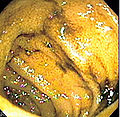 Normal small bowel mucosa as seen in double-balloon enteroscopy
 -
 Small bowel polyp observed during double-balloon enteroscopy


Ad. Transform your life with W8MD's
GLP-1 weight loss injections special from $29.99 with insurance
|
WikiMD Medical Encyclopedia |
Medical Disclaimer: WikiMD is for informational purposes only and is not a substitute for professional medical advice. Content may be inaccurate or outdated and should not be used for diagnosis or treatment. Always consult your healthcare provider for medical decisions. Verify information with trusted sources such as CDC.gov and NIH.gov. By using this site, you agree that WikiMD is not liable for any outcomes related to its content. See full disclaimer.
Credits:Most images are courtesy of Wikimedia commons, and templates, categories Wikipedia, licensed under CC BY SA or similar.
Translate this page: - East Asian
中文,
日本,
한국어,
South Asian
हिन्दी,
தமிழ்,
తెలుగు,
Urdu,
ಕನ್ನಡ,
Southeast Asian
Indonesian,
Vietnamese,
Thai,
မြန်မာဘာသာ,
বাংলা
European
español,
Deutsch,
français,
Greek,
português do Brasil,
polski,
română,
русский,
Nederlands,
norsk,
svenska,
suomi,
Italian
Middle Eastern & African
عربى,
Turkish,
Persian,
Hebrew,
Afrikaans,
isiZulu,
Kiswahili,
Other
Bulgarian,
Hungarian,
Czech,
Swedish,
മലയാളം,
मराठी,
ਪੰਜਾਬੀ,
ગુજરાતી,
Portuguese,
Ukrainian
