Balantidium coli
Balantidium coli is a protozoan parasite responsible for causing the disease balantidiasis, a primarily intestinal infection that can occasionally become systemic. This organism is notable for being the largest protozoan parasite to infect humans and is unique among ciliates for its pathogenicity. Balantidium coli has a complex life cycle, alternating between trophozoite and cyst stages, facilitating its transmission and survival in various environments.
Life Cycle
The life cycle of Balantidium coli involves two distinct stages: the trophozoite and the cyst. The trophozoite is the active, motile stage, which resides in the host's large intestine, where it can cause disease. In contrast, the cyst is the infectious stage, excreted in the feces of an infected host and capable of surviving outside the host in a dormant state until ingested by another host.
- Trophozoite Stage: In this stage, B. coli trophozoites colonize the large intestine, adhering to the mucosal lining and feeding on intestinal bacteria and nutrients. They may cause lesions and ulcers through mechanical and enzymatic action, leading to dysentery-like symptoms.
- Cyst Stage: The trophozoites undergo encystation to form cysts, which are then excreted in the feces. These cysts are hardy and can survive in moist environments for weeks to months. Infection occurs when another host ingests these cysts through contaminated water or food.
Transmission
Transmission of Balantidium coli primarily occurs through the fecal-oral route, with humans and other mammals, particularly pigs, serving as reservoir hosts. Ingestion of contaminated water or food with fecal matter containing viable cysts is the most common mode of transmission. Poor sanitation and hygiene practices are significant risk factors for balantidiasis.
Symptoms and Treatment
Balantidiasis can range from asymptomatic to severe, with symptoms including watery diarrhea, abdominal pain, and, in extreme cases, perforation of the colon. The severity of the disease is influenced by the immune status of the host and the number of cysts ingested.
Treatment typically involves antibiotics, with tetracycline being the drug of choice. Other effective medications include metronidazole and iodoquinol. Early diagnosis and treatment are crucial to prevent complications and systemic spread of the infection.
Prevention
Preventive measures for balantidiasis focus on improving sanitation and hygiene to reduce fecal contamination of water and food. This includes:
- Safe handling and disposal of human and animal feces
- Ensuring access to clean drinking water
- Practicing good personal hygiene, such as regular handwashing
- Proper food preparation and storage
Epidemiology
Balantidium coli is distributed worldwide, with higher prevalence in tropical and subtropical regions where conditions favor its survival and transmission. It is more common in areas with poor sanitation and in populations with close contact with pigs, which are significant reservoir hosts.
See Also

Balantidium_coli
-
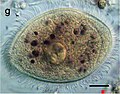 Balantidium coli trophozoite
 -
 Balantidium coli wet mount
 -
 Balantidium Life Cycle


Ad. Transform your life with W8MD's
GLP-1 weight loss injections special from $29.99 with insurance
|
WikiMD Medical Encyclopedia |
Medical Disclaimer: WikiMD is for informational purposes only and is not a substitute for professional medical advice. Content may be inaccurate or outdated and should not be used for diagnosis or treatment. Always consult your healthcare provider for medical decisions. Verify information with trusted sources such as CDC.gov and NIH.gov. By using this site, you agree that WikiMD is not liable for any outcomes related to its content. See full disclaimer.
Credits:Most images are courtesy of Wikimedia commons, and templates, categories Wikipedia, licensed under CC BY SA or similar.
Translate this page: - East Asian
中文,
日本,
한국어,
South Asian
हिन्दी,
தமிழ்,
తెలుగు,
Urdu,
ಕನ್ನಡ,
Southeast Asian
Indonesian,
Vietnamese,
Thai,
မြန်မာဘာသာ,
বাংলা
European
español,
Deutsch,
français,
Greek,
português do Brasil,
polski,
română,
русский,
Nederlands,
norsk,
svenska,
suomi,
Italian
Middle Eastern & African
عربى,
Turkish,
Persian,
Hebrew,
Afrikaans,
isiZulu,
Kiswahili,
Other
Bulgarian,
Hungarian,
Czech,
Swedish,
മലയാളം,
मराठी,
ਪੰਜਾਬੀ,
ગુજરાતી,
Portuguese,
Ukrainian
