Impossible trident
Impossible Trident
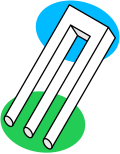
The Impossible Trident, also known as the Blivet, is an optical illusion that features a three-pronged object which paradoxically transforms into two rectangular prongs at one end. This visual anomaly belongs to the category of impossible objects, which are two-dimensional figures that appear to represent three-dimensional objects with geometric properties that cannot exist in the physical world. The Impossible Trident is a classic example of such an object, intriguing and baffling observers with its seemingly impossible structure.
Overview
The Impossible Trident illusion consists of a three-dimensional figure that, upon closer inspection, defies logical physical construction. At one end, the object appears to split into three cylindrical rods; however, as the eye follows these rods towards the other end, they somehow merge into two. This phenomenon occurs due to the clever arrangement of lines and shapes that manipulate the brain's perception of three-dimensional space, causing a conflict between the visual cues that inform depth and the logical understanding of the object's structure.
History
The origins of the Impossible Trident can be traced back to the artistic explorations of impossible figures in the 20th century. It gained prominence in the 1960s when it appeared in the Mad Magazine as a satirical illustration. Since then, it has become a subject of interest in the fields of psychology, particularly in the study of human visual perception and cognitive processes.
Perception and Interpretation
The perception of the Impossible Trident is influenced by the brain's attempt to reconcile the conflicting information it receives through visual stimuli. The human visual system is adept at interpreting two-dimensional images as three-dimensional objects based on cues such as shading, perspective, and continuity. However, the Impossible Trident disrupts these cues, leading to an intriguing perceptual puzzle.
Researchers in the field of Visual Perception have studied the Impossible Trident to understand how the brain processes impossible objects. These studies suggest that the brain's interpretation of such objects involves a dynamic reevaluation of the initial perceptual hypotheses, indicating the flexibility and adaptability of the visual system.
In Popular Culture
The Impossible Trident has made its mark in popular culture, appearing in various forms of media, including books, television shows, and artwork. Its intriguing nature has made it a favorite subject for artists exploring the theme of visual illusion and the boundaries of perception.
See Also
- Optical Illusions
- Impossible Objects
- Visual Perception
- M.C. Escher, an artist known for his works featuring impossible constructions
References
<references/>

This article is a psychology-related stub. You can help WikiMD by expanding it!
Impossible_trident
-
 Impossible trident
 -
Impossible trident

Ad. Transform your life with W8MD's
GLP-1 weight loss injections special from $29.99


W8MD Medical Weight Loss, Sleep and Medspa offers physician-supervised medical weight loss programs: NYC medical weight loss Philadelphia medical weight loss
Affordable GLP-1 Weight Loss ShotsAffordable GLP-1 Weight Loss Shots
Budget GLP-1 injections NYC (insurance & self-pay options) Popular treatments:
- Semaglutide starting from $29.99/week
- Tirzepatide starting from $45.00/week
✔ Most insurances accepted for visits ✔ Prior authorization support when eligible
Start your physician weight loss NYC journey today:
📍 NYC: Brooklyn weight loss center 📍 Philadelphia: Philadelphia weight loss center
📞 Call: 718-946-5500 (NYC) | 215-676-2334 (Philadelphia)
Tags: Affordable GLP1 weight loss NYC, Wegovy NYC, Zepbound NYC, Philadelphia medical weight loss


|
WikiMD Medical Encyclopedia |
Medical Disclaimer: WikiMD is not a substitute for professional medical advice. The information on WikiMD is provided as an information resource only, may be incorrect, outdated or misleading, and is not to be used or relied on for any diagnostic or treatment purposes. Please consult your health care provider before making any healthcare decisions or for guidance about a specific medical condition. WikiMD expressly disclaims responsibility, and shall have no liability, for any damages, loss, injury, or liability whatsoever suffered as a result of your reliance on the information contained in this site. By visiting this site you agree to the foregoing terms and conditions, which may from time to time be changed or supplemented by WikiMD. If you do not agree to the foregoing terms and conditions, you should not enter or use this site. See full disclaimer.
Credits:Most images are courtesy of Wikimedia commons, and templates, categories Wikipedia, licensed under CC BY SA or similar.
Translate this page: - East Asian
中文,
日本,
한국어,
South Asian
हिन्दी,
தமிழ்,
తెలుగు,
Urdu,
ಕನ್ನಡ,
Southeast Asian
Indonesian,
Vietnamese,
Thai,
မြန်မာဘာသာ,
বাংলা
European
español,
Deutsch,
français,
Greek,
português do Brasil,
polski,
română,
русский,
Nederlands,
norsk,
svenska,
suomi,
Italian
Middle Eastern & African
عربى,
Turkish,
Persian,
Hebrew,
Afrikaans,
isiZulu,
Kiswahili,
Other
Bulgarian,
Hungarian,
Czech,
Swedish,
മലയാളം,
मराठी,
ਪੰਜਾਬੀ,
ગુજરાતી,
Portuguese,
Ukrainian

