Cyclotide
Cyclotides are a family of peptides found in plants. They are characterized by their unique structural feature, the cyclic cystine knot (CCK) motif, which gives them exceptional stability against thermal, chemical, and enzymatic degradation. This stability, combined with their biological activities, makes cyclotides an interesting subject for research in drug design and agricultural applications.
Structure and Classification
Cyclotides typically consist of 28 to 37 amino acid residues. Their defining feature is a head-to-tail cyclized backbone, which is stabilized by three disulfide bonds forming a knotted arrangement known as the cyclic cystine knot. This unique structure endows cyclotides with remarkable stability.
Cyclotides are classified into two main families based on their sequence and biological function: the Möbius cyclotides, which contain a twist in their backbone due to a proline-induced cis-trans isomerization, and the bracelet cyclotides, which lack this twist. A third, less well-defined group, known as trypsin inhibitor cyclotides, has also been identified.
Biological Activities and Applications
Cyclotides exhibit a wide range of biological activities, including uterotonic, antimicrobial, antiviral, and insecticidal effects. Their potent insecticidal activity suggests a role in plant defense, making them of interest for agricultural applications as natural pesticides.
In medicine, the inherent stability and bioactivities of cyclotides make them promising scaffolds for drug design. Their ability to penetrate cells and affect intracellular protein-protein interactions allows for the development of novel therapeutics with applications in cancer therapy, immune disorders, and infectious diseases.
Discovery and Distribution
Cyclotides were first discovered in the 1970s in plants belonging to the Violaceae family, particularly in Viola tricolor, commonly known as pansy. Since then, they have been identified in several other plant families, including Rubiaceae, Cucurbitaceae, and Fabaceae, indicating a wide distribution across different plant species.
Synthesis and Engineering
The biosynthesis of cyclotides involves ribosomal synthesis of a precursor protein, which undergoes enzymatic processing to yield the mature cyclotide. This process includes the formation of the cyclic backbone and the establishment of disulfide bonds, leading to the characteristic cyclic cystine knot structure.
Advances in biotechnology have enabled the engineering of cyclotides for specific applications. Techniques such as molecular cloning and expression in microbial systems allow for the production of cyclotides with altered sequences, enhancing their biological activities or stability for therapeutic use.
Future Perspectives
The unique properties of cyclotides, combined with their potential for agricultural and pharmaceutical applications, make them a focus of ongoing research. Future studies aim to elucidate their mechanisms of action, improve methods for their synthesis and modification, and explore their applications in drug development and plant protection.
This peptide related article is a stub. You can help WikiMD by expanding it.
-
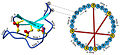 Cyclotide structure
 -
 Helicoverpa size
 -
 Cyclotides sequence table
 -
 Cyclotide biosynthesis
 -
 Kalata
 -
 Oldenlandia affinis


Ad. Transform your life with W8MD's
GLP-1 weight loss injections special from $29.99 with insurance
|
WikiMD Medical Encyclopedia |
Medical Disclaimer: WikiMD is for informational purposes only and is not a substitute for professional medical advice. Content may be inaccurate or outdated and should not be used for diagnosis or treatment. Always consult your healthcare provider for medical decisions. Verify information with trusted sources such as CDC.gov and NIH.gov. By using this site, you agree that WikiMD is not liable for any outcomes related to its content. See full disclaimer.
Credits:Most images are courtesy of Wikimedia commons, and templates, categories Wikipedia, licensed under CC BY SA or similar.
Translate this page: - East Asian
中文,
日本,
한국어,
South Asian
हिन्दी,
தமிழ்,
తెలుగు,
Urdu,
ಕನ್ನಡ,
Southeast Asian
Indonesian,
Vietnamese,
Thai,
မြန်မာဘာသာ,
বাংলা
European
español,
Deutsch,
français,
Greek,
português do Brasil,
polski,
română,
русский,
Nederlands,
norsk,
svenska,
suomi,
Italian
Middle Eastern & African
عربى,
Turkish,
Persian,
Hebrew,
Afrikaans,
isiZulu,
Kiswahili,
Other
Bulgarian,
Hungarian,
Czech,
Swedish,
മലയാളം,
मराठी,
ਪੰਜਾਬੀ,
ગુજરાતી,
Portuguese,
Ukrainian
