Conocybe apala
Conocybe apala, also known as the fragile conecap or white dunce cap, is a species of mushroom in the family Bolbitiaceae. This small, delicate mushroom is often found in lawns and grassy areas in Europe and North America, particularly during the wetter months of summer and autumn. Despite its unassuming appearance, Conocybe apala is a species of interest within the field of mycology due to its distinctive characteristics and its role in the ecosystem.
Description
Conocybe apala mushrooms are characterized by their small size, fragile structure, and pale coloration. The cap is conical or bell-shaped, measuring 1-2.5 cm in diameter, and is often a pale white or cream color. The stem is thin and fragile, growing up to 6 cm tall and 2-3 mm thick, with a similar coloration to the cap. These mushrooms do not have a ring on the stem, and the gills are adnate to adnexed, ranging in color from light brown to a more cinnamon hue as the spores mature.
Habitat and Distribution
The fragile conecap is commonly found in grassy areas, such as lawns, meadows, and parks, where it grows in small groups or clusters. It has a widespread distribution, occurring in both Europe and North America. The mushroom prefers moist conditions and is most commonly observed following periods of rain during the warmer months.
Ecology
As a saprotrophic organism, Conocybe apala plays a crucial role in its ecosystem by decomposing organic matter. This process recycles nutrients back into the soil, supporting plant growth and maintaining the health of the ecosystem. The species is part of a larger genus, Conocybe, which includes many other saprotrophic mushrooms.
Toxicity
While Conocybe apala is not known to contain the same potent toxins as some of its relatives in the genus Conocybe, such as those containing psilocybin, it is generally advised to avoid consumption. The fragile conecap has not been extensively studied for its edibility, and the risk of mistaking it for other toxic species makes it a poor choice for foraging.
Research and Conservation
Research on Conocybe apala and its relatives is ongoing, with studies focusing on their taxonomy, ecology, and potential uses in bioremediation. As a common species, Conocybe apala does not currently face any significant conservation threats. However, monitoring its population and distribution can provide valuable insights into the health of grassland ecosystems.
See Also
References
<references/> Species of fungus
Conocybe apala | |
|---|---|
 | Gills on hymenium |
 | Cap is conical |
 | Hymenium is adnate |
 | Stipe is bare |
 | Spore print is brown |
 | Ecology is saprotrophic |
 | Edibility is inedible |

-
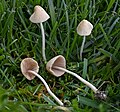 Conocybe apala in Oakland
 -
 Gill edge of Conocybe apala
 -
 Conocybe apala spores at 1000x magnification


Ad. Transform your life with W8MD's
GLP-1 weight loss injections special from $29.99 with insurance
|
WikiMD Medical Encyclopedia |
Medical Disclaimer: WikiMD is for informational purposes only and is not a substitute for professional medical advice. Content may be inaccurate or outdated and should not be used for diagnosis or treatment. Always consult your healthcare provider for medical decisions. Verify information with trusted sources such as CDC.gov and NIH.gov. By using this site, you agree that WikiMD is not liable for any outcomes related to its content. See full disclaimer.
Credits:Most images are courtesy of Wikimedia commons, and templates, categories Wikipedia, licensed under CC BY SA or similar.
Translate this page: - East Asian
中文,
日本,
한국어,
South Asian
हिन्दी,
தமிழ்,
తెలుగు,
Urdu,
ಕನ್ನಡ,
Southeast Asian
Indonesian,
Vietnamese,
Thai,
မြန်မာဘာသာ,
বাংলা
European
español,
Deutsch,
français,
Greek,
português do Brasil,
polski,
română,
русский,
Nederlands,
norsk,
svenska,
suomi,
Italian
Middle Eastern & African
عربى,
Turkish,
Persian,
Hebrew,
Afrikaans,
isiZulu,
Kiswahili,
Other
Bulgarian,
Hungarian,
Czech,
Swedish,
മലയാളം,
मराठी,
ਪੰਜਾਬੀ,
ગુજરાતી,
Portuguese,
Ukrainian
