Mark and recapture
Mark and recapture is a method used in ecology and wildlife management to estimate an animal population's size. A portion of the population is captured, marked, and then released back into the wild. Later, a second capture is made, and the number of marked individuals within this sample is counted. Since the marked individuals represent a known fraction of the total population, the total population size can be estimated using simple ratios. This method is also known by other names such as capture-recapture, tag and release, and mark-release-recapture.
Methodology
The basic premise of the mark and recapture method involves three key steps: capturing a sample of the population, marking the captured individuals in a way that is harmless and does not affect their re-capture probability, and then releasing them back into their habitat. After a certain period, a second capture is made, and the proportion of marked individuals within this sample is used to estimate the total population size using the Lincoln-Petersen index or other more sophisticated statistical models like the Schnabel method or Jolly-Seber model which account for births, deaths, immigration, and emigration.
Assumptions
For the mark and recapture method to provide accurate estimates, several assumptions must be met:
- Marked and unmarked individuals have the same probability of being captured.
- The mark is not lost or overlooked.
- The marked population is randomly mixed within the total population.
- There are no births, deaths, immigration, or emigration between sampling periods (for the simplest models).
Violations of these assumptions can lead to biased estimates of population size.
Applications
Mark and recapture techniques are widely used in the study of wildlife populations, including mammals, birds, fish, and insects. They are particularly useful for studying species that are elusive or rare, making total counts impractical or impossible. Beyond estimating population sizes, mark and recapture data can also provide insights into animal movement, survival rates, and behavior.
Ethical Considerations
While mark and recapture is a valuable tool in ecological research, it must be conducted with consideration for the welfare of the animals involved. The marking process should be harmless and not affect the individual's survival or behavior. Ethical guidelines and sometimes legal permits are required to ensure that research practices do not harm animal populations or individual animals.
See Also
References
<references />

-
 Mark and recapture
 -
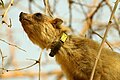 Collar tagged Rock Hyrax
 -
 Jackdaw with a ring
 -
 Mark and recapture
 -
 Coenonympha tullia CMR
 -
 Bank Vole


Ad. Transform your life with W8MD's
GLP-1 weight loss injections special from $29.99 with insurance
|
WikiMD Medical Encyclopedia |
Medical Disclaimer: WikiMD is for informational purposes only and is not a substitute for professional medical advice. Content may be inaccurate or outdated and should not be used for diagnosis or treatment. Always consult your healthcare provider for medical decisions. Verify information with trusted sources such as CDC.gov and NIH.gov. By using this site, you agree that WikiMD is not liable for any outcomes related to its content. See full disclaimer.
Credits:Most images are courtesy of Wikimedia commons, and templates, categories Wikipedia, licensed under CC BY SA or similar.
Translate this page: - East Asian
中文,
日本,
한국어,
South Asian
हिन्दी,
தமிழ்,
తెలుగు,
Urdu,
ಕನ್ನಡ,
Southeast Asian
Indonesian,
Vietnamese,
Thai,
မြန်မာဘာသာ,
বাংলা
European
español,
Deutsch,
français,
Greek,
português do Brasil,
polski,
română,
русский,
Nederlands,
norsk,
svenska,
suomi,
Italian
Middle Eastern & African
عربى,
Turkish,
Persian,
Hebrew,
Afrikaans,
isiZulu,
Kiswahili,
Other
Bulgarian,
Hungarian,
Czech,
Swedish,
മലയാളം,
मराठी,
ਪੰਜਾਬੀ,
ગુજરાતી,
Portuguese,
Ukrainian
