Maja squinado
Maja squinado is a species of decapod crustacean, more commonly known as the European spider crab or spiny spider crab. It is a marine crab that resides in the northeastern Atlantic Ocean and the Mediterranean Sea.
Taxonomy
The scientific name of the European spider crab, Maja squinado, was first described by Carl Linnaeus in his 1758 work, Systema Naturae. It belongs to the family Majidae, a group of crabs commonly referred to as spider crabs due to their long, spindly legs.
Description
Maja squinado is one of the largest crab species found in European waters. It has a rounded, spiny carapace that can reach up to 20 centimeters in width, and long, spindly legs that can span up to 60 centimeters. The crab's coloration varies from a light sandy color to a darker red or brown.
Distribution and habitat
The European spider crab is found in the northeastern Atlantic Ocean, from the British Isles to Morocco, and in the Mediterranean Sea. It inhabits a variety of habitats, from rocky shores to sandy bottoms, and can be found at depths of up to 65 meters.
Diet
Maja squinado is an omnivorous species. Its diet consists of a variety of marine organisms, including mollusks, small fish, and various types of marine vegetation.
Commercial importance
The European spider crab is commercially fished in several countries, including Spain, France, and the United Kingdom. It is considered a delicacy in many Mediterranean cuisines.
Conservation status
While Maja squinado is not currently listed as an endangered species, it is subject to overfishing in some areas. Conservation measures, such as size limits and closed seasons, have been implemented in some regions to protect the species.
.png)
This article is a crustacean-related stub. You can help WikiMD by expanding it!
-
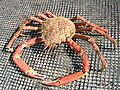 Maja squinado
 -
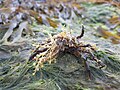 Maja squinado
 -
 Maja squinado swimming

.jpg)

Ad. Transform your life with W8MD's
GLP-1 weight loss injections special from $29.99 with insurance
|
WikiMD Medical Encyclopedia |
Medical Disclaimer: WikiMD is for informational purposes only and is not a substitute for professional medical advice. Content may be inaccurate or outdated and should not be used for diagnosis or treatment. Always consult your healthcare provider for medical decisions. Verify information with trusted sources such as CDC.gov and NIH.gov. By using this site, you agree that WikiMD is not liable for any outcomes related to its content. See full disclaimer.
Credits:Most images are courtesy of Wikimedia commons, and templates, categories Wikipedia, licensed under CC BY SA or similar.
Translate this page: - East Asian
中文,
日本,
한국어,
South Asian
हिन्दी,
தமிழ்,
తెలుగు,
Urdu,
ಕನ್ನಡ,
Southeast Asian
Indonesian,
Vietnamese,
Thai,
မြန်မာဘာသာ,
বাংলা
European
español,
Deutsch,
français,
Greek,
português do Brasil,
polski,
română,
русский,
Nederlands,
norsk,
svenska,
suomi,
Italian
Middle Eastern & African
عربى,
Turkish,
Persian,
Hebrew,
Afrikaans,
isiZulu,
Kiswahili,
Other
Bulgarian,
Hungarian,
Czech,
Swedish,
മലയാളം,
मराठी,
ਪੰਜਾਬੀ,
ગુજરાતી,
Portuguese,
Ukrainian
