Scuba skills
Scuba skills are the abilities and techniques that scuba divers learn through training and experience. They are the methods that enable divers to use scuba equipment effectively and respond to the underwater environment.
Training
Scuba training involves both theoretical and practical elements. Theoretical training covers the principles of physics and physiology that are relevant to scuba diving, as well as the operation of scuba equipment. Practical training involves learning and practicing scuba skills in a controlled environment, usually a swimming pool, before progressing to open water dives.
Basic Scuba Skills
Basic scuba skills include buoyancy control, mask clearing, regulator recovery, and emergency ascent procedures.
Buoyancy Control
Buoyancy control is the ability to adjust your buoyancy in order to hover at a specific depth or move up or down in the water column. This is achieved by adding or releasing air from the buoyancy control device (BCD).
Mask Clearing
Mask clearing is the ability to remove water from the scuba mask without removing it. This is an important skill as it allows divers to see clearly underwater.
Regulator Recovery
Regulator recovery involves retrieving the scuba regulator if it comes out of the diver's mouth. This is a critical skill as the regulator provides the diver with air from the scuba tank.
Emergency Ascent Procedures
Emergency ascent procedures are the techniques used to ascend safely in the event of an emergency. These include the controlled emergency swimming ascent (CESA) and the buddy breathing ascent.
Advanced Scuba Skills
Advanced scuba skills include navigation, deep diving, night diving, and wreck diving. These skills are usually taught in advanced scuba courses and require a higher level of knowledge and experience.
Safety
Safety is a key aspect of scuba skills. Divers are trained to monitor their air supply, avoid decompression sickness, and respond to emergencies. Regular practice of scuba skills is important for maintaining safety.
See Also
 | |
|---|---|
 |
 |
-
 Diving training
 -
 Open Water Diver
 -
 Pre-dive check in Malibu California
 -
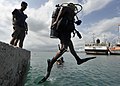 US Navy diver conducting a front step entry
 -
 US Navy diver diving into San Diego Bay
 -
 Scuba diver exiting water by stern platform ladder
 -
 Woman diving
 -
 DIR Divers Sandra Edwards


_2.jpg)
_1,_dives_into_San_Diego_Bay_to_sea.jpg)

.jpg)

Ad. Transform your life with W8MD's
GLP-1 weight loss injections special from $29.99 with insurance
|
WikiMD Medical Encyclopedia |
Medical Disclaimer: WikiMD is for informational purposes only and is not a substitute for professional medical advice. Content may be inaccurate or outdated and should not be used for diagnosis or treatment. Always consult your healthcare provider for medical decisions. Verify information with trusted sources such as CDC.gov and NIH.gov. By using this site, you agree that WikiMD is not liable for any outcomes related to its content. See full disclaimer.
Credits:Most images are courtesy of Wikimedia commons, and templates, categories Wikipedia, licensed under CC BY SA or similar.
Translate this page: - East Asian
中文,
日本,
한국어,
South Asian
हिन्दी,
தமிழ்,
తెలుగు,
Urdu,
ಕನ್ನಡ,
Southeast Asian
Indonesian,
Vietnamese,
Thai,
မြန်မာဘာသာ,
বাংলা
European
español,
Deutsch,
français,
Greek,
português do Brasil,
polski,
română,
русский,
Nederlands,
norsk,
svenska,
suomi,
Italian
Middle Eastern & African
عربى,
Turkish,
Persian,
Hebrew,
Afrikaans,
isiZulu,
Kiswahili,
Other
Bulgarian,
Hungarian,
Czech,
Swedish,
മലയാളം,
मराठी,
ਪੰਜਾਬੀ,
ગુજરાતી,
Portuguese,
Ukrainian
