TGF beta signaling pathway
TGF beta signaling pathway is a cellular pathway that plays a crucial role in regulating a variety of biological processes, including cell growth, cell differentiation, apoptosis, and homeostasis. The pathway is named after its key component, the Transforming Growth Factor beta (TGF-β), a type of cytokine that controls proliferation, cellular differentiation, and other functions in most cells.
Overview
The TGF-β signaling pathway begins when TGF-β ligands bind to a type II receptor, which recruits and phosphorylates a type I receptor. The type I receptor then phosphorylates receptor-regulated SMADs (R-SMADs), which can now bind the coSMAD SMAD4. This complex accumulates in the cell nucleus where it acts as a transcription factor and participates in the regulation of target gene expression.
Components
TGF-β
Transforming Growth Factor beta (TGF-β) is a multifunctional cytokine belonging to the transforming growth factor superfamily that includes four different isoforms (TGF-β1, TGF-β2, TGF-β3, TGF-β4) and many other signaling proteins produced by all white blood cell lineages.
Type I and Type II Receptors
The TGF beta receptors are single pass serine/threonine kinase receptors. They are composed of two types: type I and type II. Both types are required for signal transduction.
SMAD Proteins
SMAD proteins are a family of proteins similar to the gene products of the Drosophila gene 'mothers against decapentaplegic' (Mad) and the C. elegans gene Sma. SMAD proteins are signal transducers and transcriptional modulators that mediate multiple signaling pathways.
Function
The TGF-β signaling pathway is involved in a wide range of cellular processes in both the adult organism and the developing embryo including cell growth, cell differentiation, apoptosis, cellular homeostasis and other cellular functions.
Clinical Significance
Alterations in the TGF-β signaling pathway have been implicated in a variety of diseases, including cancer, fibrosis, and autoimmune diseases.
See Also
References

TGF_beta_signaling_pathway
-
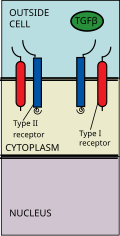 TGF-beta signaling pathway step 1
 -
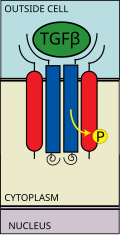 TGF-beta signaling pathway step 2
 -
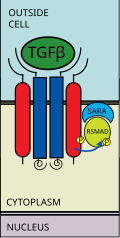 TGF-beta signaling pathway step 3
 -
 TGF-beta signaling pathway step 4
 -
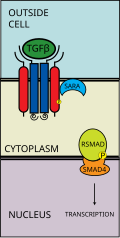 TGF-beta signaling pathway step 5


Ad. Transform your life with W8MD's
GLP-1 weight loss injections special from $29.99 with insurance
|
WikiMD Medical Encyclopedia |
Medical Disclaimer: WikiMD is for informational purposes only and is not a substitute for professional medical advice. Content may be inaccurate or outdated and should not be used for diagnosis or treatment. Always consult your healthcare provider for medical decisions. Verify information with trusted sources such as CDC.gov and NIH.gov. By using this site, you agree that WikiMD is not liable for any outcomes related to its content. See full disclaimer.
Credits:Most images are courtesy of Wikimedia commons, and templates, categories Wikipedia, licensed under CC BY SA or similar.
Translate this page: - East Asian
中文,
日本,
한국어,
South Asian
हिन्दी,
தமிழ்,
తెలుగు,
Urdu,
ಕನ್ನಡ,
Southeast Asian
Indonesian,
Vietnamese,
Thai,
မြန်မာဘာသာ,
বাংলা
European
español,
Deutsch,
français,
Greek,
português do Brasil,
polski,
română,
русский,
Nederlands,
norsk,
svenska,
suomi,
Italian
Middle Eastern & African
عربى,
Turkish,
Persian,
Hebrew,
Afrikaans,
isiZulu,
Kiswahili,
Other
Bulgarian,
Hungarian,
Czech,
Swedish,
മലയാളം,
मराठी,
ਪੰਜਾਬੀ,
ગુજરાતી,
Portuguese,
Ukrainian
