Zone of polarizing activity
Zone of Polarizing Activity
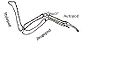
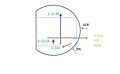
The Zone of Polarizing Activity (ZPA) is a region located at the posterior margin of the limb bud that plays a crucial role in the early development of limbs in vertebrates. It is responsible for the anterior-posterior organization (thumb to little finger axis) of the limb.
Function
The ZPA functions by secreting a protein called Sonic hedgehog (Shh), which acts as a morphogen to control the growth and patterning of the limb. The concentration gradient of Shh across the limb bud determines the identity of the digits in a dose-dependent manner. High concentrations of Shh induce the formation of posterior digits, while lower concentrations are required for the formation of anterior digits.
Discovery
The ZPA was first identified in the 1960s by John Saunders and his student John Fallon. They discovered that grafting an additional ZPA to the anterior margin of a chick limb bud resulted in a mirror-image duplication of the digits.
Role in Developmental Disorders
Abnormalities in the ZPA or its signaling pathway can lead to limb malformations such as polydactyly (extra digits) and syndactyly (fused digits). Understanding the function of the ZPA and its signaling pathway can therefore provide insights into the causes of these developmental disorders.
See Also
References
<references />
-
 Limb bud diagram
 -
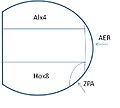 Zone of polarizing activity
 -
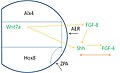 Zone of polarizing activity
 -
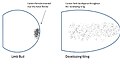 Limb bud
 -
 Zone of polarizing activity in the limb bud
 -
 Transfection
 -
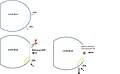 Limb bud
 -
 Zone of polarizing activity
 -
 Limb bud


.jpg)


Ad. Transform your life with W8MD's
GLP-1 weight loss injections special from $29.99 with insurance
|
WikiMD Medical Encyclopedia |
Medical Disclaimer: WikiMD is for informational purposes only and is not a substitute for professional medical advice. Content may be inaccurate or outdated and should not be used for diagnosis or treatment. Always consult your healthcare provider for medical decisions. Verify information with trusted sources such as CDC.gov and NIH.gov. By using this site, you agree that WikiMD is not liable for any outcomes related to its content. See full disclaimer.
Credits:Most images are courtesy of Wikimedia commons, and templates, categories Wikipedia, licensed under CC BY SA or similar.
Translate this page: - East Asian
中文,
日本,
한국어,
South Asian
हिन्दी,
தமிழ்,
తెలుగు,
Urdu,
ಕನ್ನಡ,
Southeast Asian
Indonesian,
Vietnamese,
Thai,
မြန်မာဘာသာ,
বাংলা
European
español,
Deutsch,
français,
Greek,
português do Brasil,
polski,
română,
русский,
Nederlands,
norsk,
svenska,
suomi,
Italian
Middle Eastern & African
عربى,
Turkish,
Persian,
Hebrew,
Afrikaans,
isiZulu,
Kiswahili,
Other
Bulgarian,
Hungarian,
Czech,
Swedish,
മലയാളം,
मराठी,
ਪੰਜਾਬੀ,
ગુજરાતી,
Portuguese,
Ukrainian
