Living wage
Living wage is a concept in labor economics that refers to a theoretical wage level that allows an individual to afford adequate shelter, food, and other basic necessities. The goal of a living wage is to ensure that all workers and their families have a basic but decent standard of living. The concept is rooted in the social contracts and economic theories of many societies, particularly in the context of social justice and labor rights.
Definition
A living wage is generally defined as a wage that is high enough to maintain a normal standard of living. This includes the ability to afford basic necessities such as housing, food, healthcare, and other essential needs. The exact amount of a living wage can vary greatly depending on the cost of living in a specific location.
Calculation
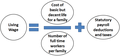
The calculation of a living wage is complex and varies from one region to another. It takes into account various factors such as the cost of food, housing, healthcare, and other basic necessities, as well as taxes and government subsidies. Some organizations, such as the Living Wage Foundation in the UK, provide a detailed methodology for calculating a living wage.
Living wage vs. minimum wage
A living wage is often compared to the minimum wage, which is the lowest wage that employers can legally pay their workers. However, the two concepts are not the same. A minimum wage is a legal requirement, while a living wage is a theoretical wage level that is often higher than the minimum wage. The living wage is intended to provide workers with a decent standard of living, while the minimum wage is often not enough to meet basic needs.
Criticism and controversy
The concept of a living wage has been the subject of much debate. Critics argue that it could lead to increased labor costs for businesses, which could in turn lead to job losses or increased prices for consumers. Supporters, on the other hand, argue that a living wage can reduce poverty and income inequality, and can lead to improved health and well-being for workers and their families.
See also

-
 Living wage
 -
 Living wage
 -
 Living wage
 -
 Living wage
 -
 Living wage
 -
 Living wage
 -
 Living wage
 -
 Living wage
 -
 Living wage
 -
 Living wage
 -
 Living wage
 -
 Living wage


.jpg)


.jpg)

.jpg)
.jpg)
.jpg)
Ad. Transform your life with W8MD's
GLP-1 weight loss injections special from $29.99 with insurance
|
WikiMD Medical Encyclopedia |
Medical Disclaimer: WikiMD is for informational purposes only and is not a substitute for professional medical advice. Content may be inaccurate or outdated and should not be used for diagnosis or treatment. Always consult your healthcare provider for medical decisions. Verify information with trusted sources such as CDC.gov and NIH.gov. By using this site, you agree that WikiMD is not liable for any outcomes related to its content. See full disclaimer.
Credits:Most images are courtesy of Wikimedia commons, and templates, categories Wikipedia, licensed under CC BY SA or similar.
Translate this page: - East Asian
中文,
日本,
한국어,
South Asian
हिन्दी,
தமிழ்,
తెలుగు,
Urdu,
ಕನ್ನಡ,
Southeast Asian
Indonesian,
Vietnamese,
Thai,
မြန်မာဘာသာ,
বাংলা
European
español,
Deutsch,
français,
Greek,
português do Brasil,
polski,
română,
русский,
Nederlands,
norsk,
svenska,
suomi,
Italian
Middle Eastern & African
عربى,
Turkish,
Persian,
Hebrew,
Afrikaans,
isiZulu,
Kiswahili,
Other
Bulgarian,
Hungarian,
Czech,
Swedish,
മലയാളം,
मराठी,
ਪੰਜਾਬੀ,
ગુજરાતી,
Portuguese,
Ukrainian
