Holy Roman Empire
Holy Roman Empire was a multi-ethnic complex of territories in Western and Central Europe that developed during the Early Middle Ages and continued until its dissolution in 1806 during the Napoleonic Wars. The largest territory of the empire after 962 was the Kingdom of Germany, though it also came to include the Kingdom of Bohemia, the Kingdom of Burgundy, the Kingdom of Italy, and numerous other territories.
Origins
The origins of the Holy Roman Empire date back to the reign of Charlemagne, who was crowned Emperor of the Romans by Pope Leo III in 800. This act established a precedent for the position of the emperor and the idea of a unified Christian empire, which was echoed in the title "Holy Roman Empire" adopted in the 10th century.
Structure
The Holy Roman Empire was not a centralized state like many others in Europe. Instead, it was divided into dozens—eventually hundreds—of individual entities, including kingdoms, duchies, counties, free imperial cities, and other domains. The emperor, elected by the prince-electors, held supreme power over the empire, but his actual power varied throughout the history of the empire.
Religion
Religion played a significant role in the Holy Roman Empire as the emperor was considered the defender of the Christian faith. Despite this, the Empire was marked by conflicts between the Pope and the Emperor, and various factions within the Empire, including those who supported the Pope, the Emperor, or neither.
Dissolution
The Holy Roman Empire was dissolved in 1806 during the Napoleonic Wars. Emperor Francis II abdicated, ending centuries of imperial rule. The territories left behind were then formed into a loose German Confederation under the leadership of the Austrian Empire.
Legacy
The Holy Roman Empire left a lasting impact on the history of Europe. Its legacy can be seen in the many states of Europe that were once part of its territory, including Germany, Austria, Switzerland, Liechtenstein, Belgium, the Netherlands, Luxembourg, Czech Republic, Slovenia, and Italy, as well as in the many cultural and architectural monuments left behind.


-
 Holy Roman Empire
 -
 Holy Roman Empire
 -
 Holy Roman Empire
 -
 Holy Roman Empire
 -
 Holy Roman Empire
 -
 Holy Roman Empire
 -
 Holy Roman Empire
 -
 Holy Roman Empire
 -
 Holy Roman Empire
 -
 Holy Roman Empire
 -
 Holy Roman Empire
 -
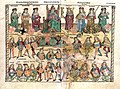 Holy Roman Empire


,_f.280v_-_BL_Royal_MS_15_E_I.jpg)


Ad. Transform your health with W8MD Weight Loss, Sleep & MedSpa

Tired of being overweight?
Special offer:
Budget GLP-1 weight loss medications
- Semaglutide starting from $29.99/week and up with insurance for visit of $59.99 and up per week self pay.
- Tirzepatide starting from $45.00/week and up (dose dependent) or $69.99/week and up self pay
✔ Same-week appointments, evenings & weekends
Learn more:
- GLP-1 weight loss clinic NYC
- W8MD's NYC medical weight loss
- W8MD Philadelphia GLP-1 shots
- Philadelphia GLP-1 injections
- Affordable GLP-1 shots NYC
|
WikiMD Medical Encyclopedia |
Medical Disclaimer: WikiMD is for informational purposes only and is not a substitute for professional medical advice. Content may be inaccurate or outdated and should not be used for diagnosis or treatment. Always consult your healthcare provider for medical decisions. Verify information with trusted sources such as CDC.gov and NIH.gov. By using this site, you agree that WikiMD is not liable for any outcomes related to its content. See full disclaimer.
Credits:Most images are courtesy of Wikimedia commons, and templates, categories Wikipedia, licensed under CC BY SA or similar.
Translate this page: - East Asian
中文,
日本,
한국어,
South Asian
हिन्दी,
தமிழ்,
తెలుగు,
Urdu,
ಕನ್ನಡ,
Southeast Asian
Indonesian,
Vietnamese,
Thai,
မြန်မာဘာသာ,
বাংলা
European
español,
Deutsch,
français,
Greek,
português do Brasil,
polski,
română,
русский,
Nederlands,
norsk,
svenska,
suomi,
Italian
Middle Eastern & African
عربى,
Turkish,
Persian,
Hebrew,
Afrikaans,
isiZulu,
Kiswahili,
Other
Bulgarian,
Hungarian,
Czech,
Swedish,
മലയാളം,
मराठी,
ਪੰਜਾਬੀ,
ગુજરાતી,
Portuguese,
Ukrainian
