Female ejaculation
Female ejaculation is a phenomenon in human female sexuality, where an expulsion of fluid occurs from the paraurethral ducts or vagina during sexual arousal or orgasm. This phenomenon has been documented in various cultures throughout history, but its nature and existence are still subjects of ongoing scientific and cultural debate.
History
The concept of female ejaculation has been acknowledged in ancient times by various cultures. In Ancient Greece, it was believed that women could produce semen similar to men, and that this fluid was crucial for conception. In Ancient India, the Kama Sutra and other texts described the female "semen" as being produced by the woman's prostate gland.
Physiology
Female ejaculation is associated with the female reproductive system, specifically the Skene's gland, also known as the female prostate. This gland is located around the urethra and can produce a fluid that is chemically similar to male semen.
During sexual arousal, the Skene's gland can fill with this fluid. During orgasm, contractions can cause this fluid to be expelled from the body, a phenomenon known as female ejaculation.
Scientific and cultural debate
The existence and nature of female ejaculation have been subjects of ongoing scientific and cultural debate. Some researchers argue that all women have the capacity to ejaculate, but that many may not realize it due to the volume of fluid being small or the fluid being mistaken for urine.
Culturally, female ejaculation has been both celebrated and stigmatized. In some cultures, it is seen as a sign of ultimate female pleasure or fertility, while in others it is viewed as unnatural or unclean.
See also
References
.svg) | This sexuality-related article is a stub. You can help WikiMD by expanding the page. |
This women's health related article is a stub. You can help WikiMD by expanding it.
-
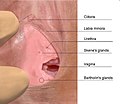 Diagram of Skene's gland
 -
 Vulva with vaginal fluid (ejaculation - squirting)

.png)
Medical Disclaimer: WikiMD is for informational purposes only and is not a substitute for professional medical advice. Content may be inaccurate or outdated and should not be used for diagnosis or treatment. Always consult your healthcare provider for medical decisions. Verify information with trusted sources such as CDC.gov and NIH.gov. By using this site, you agree that WikiMD is not liable for any outcomes related to its content. See full disclaimer.
Credits:Most images are courtesy of Wikimedia commons, and templates, categories Wikipedia, licensed under CC BY SA or similar.
Translate this page: - East Asian
中文,
日本,
한국어,
South Asian
हिन्दी,
தமிழ்,
తెలుగు,
Urdu,
ಕನ್ನಡ,
Southeast Asian
Indonesian,
Vietnamese,
Thai,
မြန်မာဘာသာ,
বাংলা
European
español,
Deutsch,
français,
Greek,
português do Brasil,
polski,
română,
русский,
Nederlands,
norsk,
svenska,
suomi,
Italian
Middle Eastern & African
عربى,
Turkish,
Persian,
Hebrew,
Afrikaans,
isiZulu,
Kiswahili,
Other
Bulgarian,
Hungarian,
Czech,
Swedish,
മലയാളം,
मराठी,
ਪੰਜਾਬੀ,
ગુજરાતી,
Portuguese,
Ukrainian
