Multiplication
Multiplication is one of the four basic operations in arithmetic, along with addition, subtraction, and division. It is the mathematical operation of scaling one number by another. It is one of the three basic elements of elementary arithmetic.
Definition
In arithmetic, multiplication is a binary operation that takes a pair of numbers, multiplies them together, and produces a product. The process of multiplication is based on the addition of numbers.
Properties
Multiplication has several important properties:
- Commutative: Changing the order of the numbers does not change the product.
- Associative: Grouping of numbers does not change the product.
- Distributive: The product of a number and a sum is equal to the sum of the individual products of the number and each addend.
- Identity: The product of any number and one is that number.
- Zero: The product of any number and zero is zero.
Multiplication in different number systems
Multiplication can be performed in various number systems, including:
See also
 | This medical article is a stub. You can help WikiMD by expanding the page. |
Multiplication
-
 Multiply 4 bags 3 marbles
 -
 Multiply scaling
 -
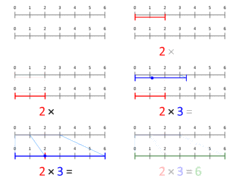 Multiplication as scaling integers
 -
 Multiplication scheme 4 by 5
 -
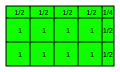 Multiply field fract
 -
 Three by Four
 -
 Komplexe zahlenebene
 -
 Multiplication algorithm
 -
 Gelosia multiplication 45 256
 -
 Multiplication chart


Medical Disclaimer: WikiMD is for informational purposes only and is not a substitute for professional medical advice. Content may be inaccurate or outdated and should not be used for diagnosis or treatment. Always consult your healthcare provider for medical decisions. Verify information with trusted sources such as CDC.gov and NIH.gov. By using this site, you agree that WikiMD is not liable for any outcomes related to its content. See full disclaimer.
Credits:Most images are courtesy of Wikimedia commons, and templates, categories Wikipedia, licensed under CC BY SA or similar.
Translate this page: - East Asian
中文,
日本,
한국어,
South Asian
हिन्दी,
தமிழ்,
తెలుగు,
Urdu,
ಕನ್ನಡ,
Southeast Asian
Indonesian,
Vietnamese,
Thai,
မြန်မာဘာသာ,
বাংলা
European
español,
Deutsch,
français,
Greek,
português do Brasil,
polski,
română,
русский,
Nederlands,
norsk,
svenska,
suomi,
Italian
Middle Eastern & African
عربى,
Turkish,
Persian,
Hebrew,
Afrikaans,
isiZulu,
Kiswahili,
Other
Bulgarian,
Hungarian,
Czech,
Swedish,
മലയാളം,
मराठी,
ਪੰਜਾਬੀ,
ગુજરાતી,
Portuguese,
Ukrainian
