Reptile
Reptile
Reptiles are a group of vertebrates comprising today's turtles, crocodilians, snakes, amphisbaenians, lizards, tuatara, and their extinct relatives. The study of these traditional reptile orders, historically combined with that of modern amphibians, is called herpetology.
Characteristics
Because they are defined paraphyletically, not all reptiles are closely related. They do share some morphological and physiological characteristics.
Cold-bloodedness
The majority of reptile species are ectothermic, which means that their internal body temperature depends on the ambient environment temperature.
Scales
Reptiles are known for their scales. Reptile scales vary in size, shape, and texture, and are typically keratinous, but there are some exceptions, such as the scales of turtles and crocodiles.
Heart
The heart has two atria and one ventricle. The ventricle is incompletely separated into two by a wall, giving the reptile heart a unique structure.
Classification
Reptiles are classified into four orders:
- Testudines: Turtles
- Squamata: Lizards, snakes and amphisbaenians
- Crocodilia: Crocodiles, gavials, caimans, and alligators
- Rhynchocephalia: Tuatara
Evolution
Reptiles first appear in the fossil record 315 million years ago and were the dominant animals during the Mesozoic era, which lasted for 270 million years until the extinction of the dinosaurs.
See also
 | |
|---|---|
 |
 |
Reptile
-
 TWC Wildlife Centre Stewart Nimmo MRD 8910
 -
 Saltwater Crocodile (Maximo)
 -
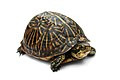 Florida Box Turtle Digon3
 -
 Rhinechis scalaris cropped
 -
 Reptile 003d
 -
 Mosasaur Discovery
 -
 Captorhinus aguti
 -
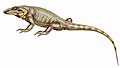 Varanodon 1DB
 -
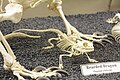 Bearded Dragon Skeleton
 -
 Milleretta BW flipped
 -
 Lanthanosuchus NT flipped

.jpg)


Ad. Transform your life with W8MD's
GLP-1 weight loss injections special from $29.99 with insurance
|
WikiMD Medical Encyclopedia |
Medical Disclaimer: WikiMD is for informational purposes only and is not a substitute for professional medical advice. Content may be inaccurate or outdated and should not be used for diagnosis or treatment. Always consult your healthcare provider for medical decisions. Verify information with trusted sources such as CDC.gov and NIH.gov. By using this site, you agree that WikiMD is not liable for any outcomes related to its content. See full disclaimer.
Credits:Most images are courtesy of Wikimedia commons, and templates, categories Wikipedia, licensed under CC BY SA or similar.
Translate this page: - East Asian
中文,
日本,
한국어,
South Asian
हिन्दी,
தமிழ்,
తెలుగు,
Urdu,
ಕನ್ನಡ,
Southeast Asian
Indonesian,
Vietnamese,
Thai,
မြန်မာဘာသာ,
বাংলা
European
español,
Deutsch,
français,
Greek,
português do Brasil,
polski,
română,
русский,
Nederlands,
norsk,
svenska,
suomi,
Italian
Middle Eastern & African
عربى,
Turkish,
Persian,
Hebrew,
Afrikaans,
isiZulu,
Kiswahili,
Other
Bulgarian,
Hungarian,
Czech,
Swedish,
മലയാളം,
मराठी,
ਪੰਜਾਬੀ,
ગુજરાતી,
Portuguese,
Ukrainian
