Echinoderm
Echinoderm is a phylum of marine animals found at various depths in the oceans. The phylum includes starfish, sea urchins, sand dollars, and sea cucumbers. Echinoderms are characterized by radial symmetry, a water vascular system, and a calcareous endoskeleton.
Characteristics
Echinoderms are unique among animals in having a water vascular system, which is a network of hydraulic canals branching into extensions called tube feet. These tube feet function in locomotion, feeding, and respiration.
Echinoderms also possess a calcareous endoskeleton that consists of plates or ossicles. These ossicles may be fused together, as in sea urchins, or articulated, as in sea stars.
Classification
The phylum Echinodermata is divided into five extant classes:
- Asteroidea (starfish or sea stars)
- Ophiuroidea (brittle stars)
- Echinoidea (sea urchins and sand dollars)
- Crinoidea (sea lilies and feather stars)
- Holothuroidea (sea cucumbers)
Ecology and life history
Echinoderms are exclusively marine and are found at every ocean depth. They play important roles in marine, benthic ecosystems. Many echinoderms are suspension feeders that capture plankton and detritus from the water column.
Echinoderms have a variety of reproductive strategies. Most species are dioecious and have external fertilization, but some species are hermaphroditic or have internal fertilization.
Evolution
The echinoderms are an ancient group, with fossils dating back to the Cambrian period. They have undergone significant evolutionary changes, including a shift from bilateral to radial symmetry.
See also
References
<references />
 | |
|---|---|
 |
 |
Echinoderm
-
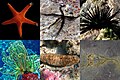 Echinoderm
 -
 Ophionereis reticulata
 -
 Sea cucumber at Pulau Redang
 -
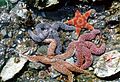 Echinoderm
 -
 Strongylocentrotus purpuratus
 -
 Crinoid on the reef of Batu Moncho Island
 -
 Diagram of water-vascular system of a starfish
 -
 Sea star regenerating legs
 -
 Comet form of Linckia
 -
 Pluteus
 -
 Podia de Colobocentrotus atratus
 -
 Neothyonidium magnum (Burrowing sea cucumber)


.jpg)
Ad. Transform your life with W8MD's
GLP-1 weight loss injections special from $29.99 with insurance
|
WikiMD Medical Encyclopedia |
Medical Disclaimer: WikiMD is for informational purposes only and is not a substitute for professional medical advice. Content may be inaccurate or outdated and should not be used for diagnosis or treatment. Always consult your healthcare provider for medical decisions. Verify information with trusted sources such as CDC.gov and NIH.gov. By using this site, you agree that WikiMD is not liable for any outcomes related to its content. See full disclaimer.
Credits:Most images are courtesy of Wikimedia commons, and templates, categories Wikipedia, licensed under CC BY SA or similar.
Translate this page: - East Asian
中文,
日本,
한국어,
South Asian
हिन्दी,
தமிழ்,
తెలుగు,
Urdu,
ಕನ್ನಡ,
Southeast Asian
Indonesian,
Vietnamese,
Thai,
မြန်မာဘာသာ,
বাংলা
European
español,
Deutsch,
français,
Greek,
português do Brasil,
polski,
română,
русский,
Nederlands,
norsk,
svenska,
suomi,
Italian
Middle Eastern & African
عربى,
Turkish,
Persian,
Hebrew,
Afrikaans,
isiZulu,
Kiswahili,
Other
Bulgarian,
Hungarian,
Czech,
Swedish,
മലയാളം,
मराठी,
ਪੰਜਾਬੀ,
ગુજરાતી,
Portuguese,
Ukrainian
