Rhodanese
Rhodanese is an enzyme that plays a crucial role in the detoxification process of cyanide in living organisms. It is found in various tissues, including the liver, kidneys, and intestines. Rhodanese catalyzes the conversion of cyanide into thiocyanate, a less toxic compound that can be easily excreted from the body.
Function
Rhodanese is primarily responsible for the detoxification of cyanide, a highly toxic compound that can be found in various sources, such as certain plants, industrial chemicals, and even cigarette smoke. Cyanide inhibits the proper functioning of cytochrome c oxidase, an enzyme involved in cellular respiration. By converting cyanide into thiocyanate, rhodanese prevents the accumulation of cyanide in the body and protects against its harmful effects.
Mechanism of Action
The mechanism by which rhodanese converts cyanide into thiocyanate involves the transfer of a sulfur atom from a sulfur donor molecule, such as thiosulfate, to cyanide. This sulfur transfer reaction results in the formation of thiocyanate and the regeneration of the sulfur donor molecule. Rhodanese acts as a catalyst in this reaction, facilitating the transfer of the sulfur atom without being consumed in the process.
Importance in Detoxification
The detoxification of cyanide by rhodanese is crucial for the survival of organisms exposed to cyanide-containing substances. Cyanide poisoning can lead to severe health complications, including respiratory failure, cardiovascular collapse, and even death. Rhodanese helps prevent these adverse effects by rapidly converting cyanide into thiocyanate, which can be safely eliminated from the body through urine.
Clinical Significance
Rhodanese deficiency in humans is a rare genetic disorder that can lead to an increased susceptibility to cyanide poisoning. Individuals with this condition may experience symptoms such as headache, dizziness, nausea, and confusion after exposure to cyanide. Diagnosis of rhodanese deficiency is typically confirmed through genetic testing. Treatment options for cyanide poisoning in individuals with rhodanese deficiency may include the administration of specific antidotes, such as hydroxocobalamin or sodium thiosulfate.
References
1. Rhodanese - Wikipedia 2. Rhodanese deficiency - PubMed
See Also
-
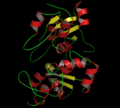 Rhodanase
 -
 Rhodanase2


Ad. Transform your health with W8MD Weight Loss, Sleep & MedSpa

Tired of being overweight?
Special offer:
Budget GLP-1 weight loss medications
- Semaglutide starting from $29.99/week and up with insurance for visit of $59.99 and up per week self pay.
- Tirzepatide starting from $45.00/week and up (dose dependent) or $69.99/week and up self pay
✔ Same-week appointments, evenings & weekends
Learn more:
- GLP-1 weight loss clinic NYC
- W8MD's NYC medical weight loss
- W8MD Philadelphia GLP-1 shots
- Philadelphia GLP-1 injections
- Affordable GLP-1 shots NYC
|
WikiMD Medical Encyclopedia |
Medical Disclaimer: WikiMD is for informational purposes only and is not a substitute for professional medical advice. Content may be inaccurate or outdated and should not be used for diagnosis or treatment. Always consult your healthcare provider for medical decisions. Verify information with trusted sources such as CDC.gov and NIH.gov. By using this site, you agree that WikiMD is not liable for any outcomes related to its content. See full disclaimer.
Credits:Most images are courtesy of Wikimedia commons, and templates, categories Wikipedia, licensed under CC BY SA or similar.
Translate this page: - East Asian
中文,
日本,
한국어,
South Asian
हिन्दी,
தமிழ்,
తెలుగు,
Urdu,
ಕನ್ನಡ,
Southeast Asian
Indonesian,
Vietnamese,
Thai,
မြန်မာဘာသာ,
বাংলা
European
español,
Deutsch,
français,
Greek,
português do Brasil,
polski,
română,
русский,
Nederlands,
norsk,
svenska,
suomi,
Italian
Middle Eastern & African
عربى,
Turkish,
Persian,
Hebrew,
Afrikaans,
isiZulu,
Kiswahili,
Other
Bulgarian,
Hungarian,
Czech,
Swedish,
മലയാളം,
मराठी,
ਪੰਜਾਬੀ,
ગુજરાતી,
Portuguese,
Ukrainian
