Peripatetic school
Peripatetic School
The Peripatetic school, also known as the Aristotelian school, was a philosophical tradition founded by the ancient Greek philosopher Aristotle. The name "Peripatetic" comes from the Greek word "peripatetikos," which means "walking about" or "strolling." This name was given to the school because Aristotle was known to teach his students while walking around the Lyceum, a public space in Athens.
History
The Peripatetic school was established by Aristotle in the 4th century BCE. Aristotle was a student of Plato and later became a teacher himself. He founded the Lyceum as a place for intellectual discussions and philosophical teachings. The school gained popularity and attracted many students, who became known as the Peripatetics.
After Aristotle's death, his successor Theophrastus continued to lead the school and further developed its teachings. The Peripatetic school flourished for several centuries, with notable philosophers such as Strato of Lampsacus and Alexander of Aphrodisias contributing to its growth.
Philosophy
The Peripatetic school focused on a wide range of subjects, including metaphysics, ethics, logic, biology, and physics. Aristotle's philosophy formed the core of the school's teachings. He believed in the importance of empirical observation and logical reasoning to understand the natural world.
One of the key concepts in Peripatetic philosophy was the idea of hylomorphism, which posits that all substances are composed of matter and form. According to Aristotle, matter is the potentiality of a substance, while form is its actuality. This theory influenced various fields, including biology and psychology.
Influence
The Peripatetic school had a significant influence on Western philosophy and science. Its teachings were preserved and disseminated throughout the Hellenistic period and the Middle Ages. Many prominent philosophers, such as Thomas Aquinas, were heavily influenced by Aristotelian thought.
The Peripatetic school also played a crucial role in the development of the scientific method. Aristotle's emphasis on empirical observation and logical reasoning laid the foundation for the scientific approach to studying the natural world.
Legacy
Although the Peripatetic school declined in popularity after the Hellenistic period, its influence can still be seen in contemporary philosophy and science. Many universities and academic institutions continue to study and teach Aristotle's works, ensuring the perpetuation of the Peripatetic tradition.
See Also
References
<references />
-
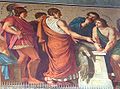 Aristotle and his disciples
 -
 School of Aristotle


Ad. Transform your life with W8MD's
GLP-1 weight loss injections special from $29.99


W8MD Medical Weight Loss, Sleep and Medspa offers physician-supervised medical weight loss programs: NYC medical weight loss Philadelphia medical weight loss
Affordable GLP-1 Weight Loss ShotsAffordable GLP-1 Weight Loss Shots
Budget GLP-1 injections NYC (insurance & self-pay options) Popular treatments:
- Semaglutide starting from $29.99/week
- Tirzepatide starting from $45.00/week
✔ Most insurances accepted for visits ✔ Prior authorization support when eligible
Start your physician weight loss NYC journey today:
📍 NYC: Brooklyn weight loss center 📍 Philadelphia: Philadelphia weight loss center
📞 Call: 718-946-5500 (NYC) | 215-676-2334 (Philadelphia)
Tags: Affordable GLP1 weight loss NYC, Wegovy NYC, Zepbound NYC, Philadelphia medical weight loss


|
WikiMD Medical Encyclopedia |
Medical Disclaimer: WikiMD is not a substitute for professional medical advice. The information on WikiMD is provided as an information resource only, may be incorrect, outdated or misleading, and is not to be used or relied on for any diagnostic or treatment purposes. Please consult your health care provider before making any healthcare decisions or for guidance about a specific medical condition. WikiMD expressly disclaims responsibility, and shall have no liability, for any damages, loss, injury, or liability whatsoever suffered as a result of your reliance on the information contained in this site. By visiting this site you agree to the foregoing terms and conditions, which may from time to time be changed or supplemented by WikiMD. If you do not agree to the foregoing terms and conditions, you should not enter or use this site. See full disclaimer.
Credits:Most images are courtesy of Wikimedia commons, and templates, categories Wikipedia, licensed under CC BY SA or similar.
Translate this page: - East Asian
中文,
日本,
한국어,
South Asian
हिन्दी,
தமிழ்,
తెలుగు,
Urdu,
ಕನ್ನಡ,
Southeast Asian
Indonesian,
Vietnamese,
Thai,
မြန်မာဘာသာ,
বাংলা
European
español,
Deutsch,
français,
Greek,
português do Brasil,
polski,
română,
русский,
Nederlands,
norsk,
svenska,
suomi,
Italian
Middle Eastern & African
عربى,
Turkish,
Persian,
Hebrew,
Afrikaans,
isiZulu,
Kiswahili,
Other
Bulgarian,
Hungarian,
Czech,
Swedish,
മലയാളം,
मराठी,
ਪੰਜਾਬੀ,
ગુજરાતી,
Portuguese,
Ukrainian
