Heart rate
Heart rate is the rate at which the heart pumps blood, measured in the number of heartbeats per minute (bpm). It is an important indicator of cardiovascular health, physical fitness, and overall wellness. The heart rate can vary depending on factors such as age, physical activity, emotional state, and overall health.
Normal range
The normal range for resting heart rate varies depending on age, fitness level, and individual factors. For adults, a normal resting heart rate typically falls between 60 and 100 bpm. Well-trained athletes may have a lower resting heart rate, sometimes as low as 40 bpm.
Children and infants have higher normal resting heart rates than adults. For example, newborns typically have a resting heart rate between 100 and 160 bpm, while older children may have a resting heart rate between 70 and 100 bpm.
During physical activity, the heart rate increases to supply more oxygen and nutrients to the muscles. The maximum heart rate varies by age, with younger individuals generally having a higher maximum heart rate than older individuals.
Factors affecting heart rate
Several factors can influence an individual's heart rate, including:
- Age: Heart rate generally decreases with age
- Physical fitness: Well-trained athletes often have a lower resting heart rate
- Emotional state: Anxiety, stress, or strong emotions can temporarily increase heart rate
- Medications: Some medications, such as beta-blockers, can affect heart rate
- Body position: Heart rate may change slightly when standing up, sitting, or lying down
- Dehydration: Dehydration can cause an increase in heart rate
- Temperature: Both external temperatures and body temperature can affect heart rate
Measuring heart rate
Heart rate can be measured using various methods, including:
- Manually: By placing two fingers (usually the index and middle fingers) on the wrist, neck, or other pulse point and counting the number of beats in a set period (usually 15 seconds) and then multiplying by four to calculate the bpm
- Electronic devices: Heart rate monitors, smartwatches, or fitness trackers that use sensors to measure heart rate
- Monitoring heart rate during exercise can help individuals maintain an appropriate intensity level and track improvements in their cardiovascular fitness over time.
See also
 | |
|---|---|
 |
 |
-
 Normal electrocardiogram
 -
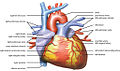 Heart anatomy
 -
 Automatic innervation
 -
 Depolarization in sinus rhythm
 -
 Dolphin encounter
 -
 Conditioned variation in heart rate during static breath-holds in the bottlenose dolphin
 -
 VivoSense heart rate vs tidal volume
 -
Athletic bradycardia
-
10 min max heart rate
-
 Exercise zones Fox and Haskell
 -
 Maximum heart rate by age various formulae
 -
 EHR-BBII


_%E2%80%93_examples_of_instantaneous_heart_rate_(ifH)_responses.jpg)


Ad. Transform your life with W8MD's
GLP-1 weight loss injections special from $29.99 with insurance
|
WikiMD Medical Encyclopedia |
Medical Disclaimer: WikiMD is for informational purposes only and is not a substitute for professional medical advice. Content may be inaccurate or outdated and should not be used for diagnosis or treatment. Always consult your healthcare provider for medical decisions. Verify information with trusted sources such as CDC.gov and NIH.gov. By using this site, you agree that WikiMD is not liable for any outcomes related to its content. See full disclaimer.
Credits:Most images are courtesy of Wikimedia commons, and templates, categories Wikipedia, licensed under CC BY SA or similar.
Translate this page: - East Asian
中文,
日本,
한국어,
South Asian
हिन्दी,
தமிழ்,
తెలుగు,
Urdu,
ಕನ್ನಡ,
Southeast Asian
Indonesian,
Vietnamese,
Thai,
မြန်မာဘာသာ,
বাংলা
European
español,
Deutsch,
français,
Greek,
português do Brasil,
polski,
română,
русский,
Nederlands,
norsk,
svenska,
suomi,
Italian
Middle Eastern & African
عربى,
Turkish,
Persian,
Hebrew,
Afrikaans,
isiZulu,
Kiswahili,
Other
Bulgarian,
Hungarian,
Czech,
Swedish,
മലയാളം,
मराठी,
ਪੰਜਾਬੀ,
ગુજરાતી,
Portuguese,
Ukrainian
