Phialophora: Difference between revisions
CSV import Tags: mobile edit mobile web edit |
No edit summary |
||
| Line 44: | Line 44: | ||
[[Category:Ascomycota]] | [[Category:Ascomycota]] | ||
[[Category:Pathogenic fungi]] | [[Category:Pathogenic fungi]] | ||
<gallery> | <gallery> | ||
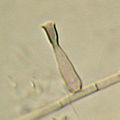
File:Phialophora verrucosa 002.jpg|Phialophora verrucosa | File:Phialophora verrucosa 002.jpg|Phialophora verrucosa | ||
</gallery> | </gallery> | ||
Latest revision as of 00:57, 17 March 2025
Phialophora is a genus of fungi within the family Herpotrichiellaceae. This genus is notable for its role in human and animal health, as some species are known to be opportunistic pathogens. Phialophora species are commonly found in soil, decaying plant matter, and other organic substrates.
Morphology[edit]
Phialophora species are characterized by their conidia production. The conidia are produced in a distinctive flask-shaped structure called a phialide, which is where the genus gets its name. The phialides are typically short and cylindrical, and they produce conidia in a basipetal succession, meaning the oldest conidia are at the tip and the youngest are at the base.
Pathogenicity[edit]
Some species of Phialophora are known to cause chromoblastomycosis, a chronic fungal infection of the skin and subcutaneous tissue. This condition is characterized by the formation of verrucous lesions and is often difficult to treat. The infection is typically acquired through traumatic implantation of the fungus into the skin, often in tropical and subtropical regions.
Species[edit]
The genus Phialophora includes several species, some of which are:
- Phialophora verrucosa
- Phialophora richardsiae
- Phialophora americana
Diagnosis[edit]
Diagnosis of infections caused by Phialophora species involves clinical examination, histopathological analysis, and culture of the organism. The characteristic sclerotic bodies, also known as "copper pennies," can be observed in tissue samples. Culturing the organism on appropriate media can help in identifying the specific species involved.
Treatment[edit]
Treatment of Phialophora infections can be challenging. Antifungal therapy often involves the use of itraconazole or terbinafine, but surgical excision of lesions may also be necessary. The choice of treatment depends on the severity and extent of the infection.
Also see[edit]

-
 Phialophora verrucosa

