PMSF: Difference between revisions
CSV import |
No edit summary |
||
| Line 26: | Line 26: | ||
{{Chem-stub}} | {{Chem-stub}} | ||
<gallery> | <gallery> | ||
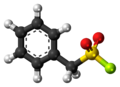
File:PMSF-3D-balls.png|PMSF 3D balls | File:PMSF-3D-balls.png|PMSF 3D balls | ||
</gallery> | </gallery> | ||
Latest revision as of 00:56, 17 March 2025
Phenylmethylsulfonyl fluoride (PMSF) is a serine protease inhibitor commonly used in the preparation of cell lysates and in the study of enzyme kinetics and mechanisms. It is an irreversible inhibitor that reacts with the serine residue in the active site of proteases, such as chymotrypsin, trypsin, and thrombin, thereby preventing the protease from cleaving peptide bonds. Due to its mechanism of action, PMSF is widely utilized in biochemistry and molecular biology to prevent protein degradation during cell lysis and extract preparation.
Properties[edit]
PMSF is a white crystalline solid with the chemical formula C_7H_7FO_2S. It is poorly soluble in water but highly soluble in organic solvents such as ethanol, methanol, and isopropanol. PMSF is also highly volatile and sensitive to hydrolysis, especially in aqueous solutions, where it has a half-life of approximately 30 minutes at pH 7.5. Therefore, it is usually added to the lysis buffers immediately before use.
Mechanism of Action[edit]
PMSF acts by irreversibly inhibiting serine proteases. It achieves this by sulfonylating the hydroxyl group of the serine residue in the active site of the enzyme. This modification blocks the serine residue from participating in the catalytic mechanism of the enzyme, effectively inactivating the protease. The irreversible nature of this inhibition makes PMSF a potent tool for studying protease function and regulation.
Applications[edit]
PMSF is extensively used in the field of molecular biology and biochemistry for:
- Inhibiting serine proteases in cell lysates to prevent protein degradation.
- Studying the mechanism of action and kinetics of serine proteases.
- Investigating the role of serine proteases in various biological processes and diseases.
Safety and Handling[edit]
PMSF is highly toxic and should be handled with care. It is a potent neurotoxin and can be absorbed through the skin, inhaled, or ingested, leading to severe health effects. Appropriate safety measures, including the use of gloves, goggles, and fume hoods, are essential when working with PMSF. Additionally, due to its instability in water, PMSF solutions should be prepared fresh and used promptly.
See Also[edit]

-
 PMSF 3D balls

