Lateral funiculus: Difference between revisions
CSV import |
No edit summary |
||
| Line 28: | Line 28: | ||
[[Category:Spinal cord]] | [[Category:Spinal cord]] | ||
{{neuroanatomy-stub}} | {{neuroanatomy-stub}} | ||
<gallery> | <gallery> | ||
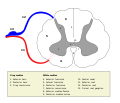
File:Medulla_spinalis_-_Section_-_English.svg|Medulla spinalis - Section - English | File:Medulla_spinalis_-_Section_-_English.svg|Medulla spinalis - Section - English | ||
</gallery> | </gallery> | ||
Latest revision as of 00:33, 17 March 2025
Lateral funiculus is a part of the white matter of the spinal cord that contains ascending and descending nerve fibers. It is located on either side of the spinal cord, between the posterior horn and the anterior horn of the grey matter.
Anatomy[edit]
The lateral funiculus is one of the three funiculi of the spinal cord, the other two being the anterior funiculus and the posterior funiculus. It is situated between the anterior and posterior roots of the spinal nerves. The lateral funiculus contains both ascending and descending nerve fibers.
Function[edit]
The lateral funiculus carries several important tracts, or bundles of nerve fibers, that transmit information between the brain and the body. These include:
- The lateral corticospinal tract, which carries motor commands from the brain to the body.
- The spinothalamic tract, which carries sensory information about pain and temperature from the body to the brain.
- The spinocerebellar tract, which carries sensory information about the position and movement of the body parts to the cerebellum.
Clinical significance[edit]
Damage to the lateral funiculus can result in a variety of neurological symptoms, depending on the specific tracts that are affected. For example, damage to the lateral corticospinal tract can result in muscle weakness or paralysis, while damage to the spinothalamic tract can result in loss of pain and temperature sensation.
See also[edit]

This article is a neuroanatomy stub. You can help WikiMD by expanding it!
-
 Medulla spinalis - Section - English

