Keratin disease: Difference between revisions
CSV import |
No edit summary |
||
| Line 29: | Line 29: | ||
{{Genetics-stub}} | {{Genetics-stub}} | ||
{{Dermatology-stub}} | {{Dermatology-stub}} | ||
<gallery> | <gallery> | ||
File:Keratin.jpg|Keratin disease | File:Keratin.jpg|Keratin disease | ||
</gallery> | </gallery> | ||
Revision as of 00:14, 17 March 2025
Keratin Disease is a group of genetic disorders that affect the keratin proteins in the body. These diseases are characterized by the abnormal structure or function of keratin, leading to a variety of skin and hair conditions.
Overview
Keratin is a type of protein that is a key component of the skin, hair, and nails. It provides strength and resilience to these tissues, protecting them from damage. In keratin diseases, mutations in the genes that encode keratin proteins lead to abnormalities in the structure or function of these proteins. This can result in a range of skin and hair conditions, including ichthyosis, epidermolysis bullosa simplex, and pachyonychia congenita.
Types of Keratin Disease
There are several types of keratin disease, each associated with mutations in different keratin genes. These include:
- Epidermolysis bullosa simplex (EBS): This is a skin condition characterized by the formation of blisters following minor trauma or friction. It is caused by mutations in the KRT5 or KRT14 genes, which encode keratin 5 and keratin 14, respectively.
- Pachyonychia congenita (PC): This is a condition characterized by thickened nails, painful blisters and calluses on the soles of the feet, and other skin abnormalities. It is caused by mutations in the KRT6A, KRT6B, KRT16, or KRT17 genes.
- Ichthyosis: This is a group of skin disorders characterized by dry, scaly skin. Some forms of ichthyosis are caused by mutations in keratin genes.
Diagnosis and Treatment
Diagnosis of keratin diseases typically involves a physical examination, a review of the patient's medical history, and genetic testing to identify mutations in keratin genes. Treatment is usually aimed at managing symptoms and may include the use of moisturizers and keratolytic agents to soften and remove scales, as well as measures to prevent skin trauma and blister formation.
See Also
 | This medical article is a stub. You can help WikiMD by expanding the page. |

 | This dermatology article is a stub. You can help WikiMD by expanding the page. |
-
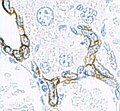 Keratin disease

