Keratic precipitate: Difference between revisions
CSV import |
No edit summary |
||
| Line 26: | Line 26: | ||
{{Eye-disease-stub}} | {{Eye-disease-stub}} | ||
{{Medicine-stub}} | {{Medicine-stub}} | ||
<gallery> | <gallery> | ||
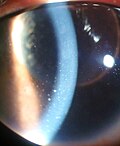
File:Keratic precipitate2.jpg|Keratic precipitate | File:Keratic precipitate2.jpg|Keratic precipitate | ||
</gallery> | </gallery> | ||
Revision as of 00:14, 17 March 2025
Keratic precipitate (KP) is a clinical term used in ophthalmology to describe inflammatory cells that have deposited on the cornea of the eye. These deposits are often associated with various eye diseases and conditions, particularly those involving inflammation of the uvea, the middle layer of the eye.
Overview
Keratic precipitates are typically observed during a slit lamp examination by an ophthalmologist. They appear as small, white or yellowish deposits on the inner surface of the cornea, known as the endothelium. The size, shape, and distribution of these deposits can vary, and these characteristics can help in diagnosing specific eye conditions.
Causes
Keratic precipitates are most commonly associated with uveitis, an inflammation of the uvea. They can also occur in other conditions such as Fuchs' dystrophy, herpes simplex keratitis, and Posner-Schlossman syndrome. In some cases, keratic precipitates may be a sign of a systemic disease affecting other parts of the body, such as sarcoidosis or tuberculosis.
Types
There are three main types of keratic precipitates: mutton-fat KPs, stellate KPs, and pigmented KPs.
- Mutton-fat KPs are large, greasy-looking deposits that are typically associated with granulomatous uveitis, a type of inflammation that involves the formation of granulomas.
- Stellate KPs are smaller and star-shaped. They are often seen in non-granulomatous uveitis.
- Pigmented KPs contain melanin, a pigment that gives them a brown or black color. They are often seen in chronic uveitis and are sometimes referred to as "starry sky" KPs due to their appearance.
Treatment
The treatment for keratic precipitates primarily involves addressing the underlying cause. This may involve the use of anti-inflammatory medications, immunosuppressive drugs, or antibiotics, depending on the specific condition. In some cases, surgery may be necessary.


-
 Keratic precipitate

