Hexahydrocannabivarin: Difference between revisions
CSV import |
No edit summary |
||
| Line 30: | Line 30: | ||
{{pharmacology-stub}} | {{pharmacology-stub}} | ||
<gallery> | <gallery> | ||
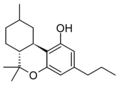
File:HHCV structure.png|Hexahydrocannabivarin | File:HHCV structure.png|Hexahydrocannabivarin | ||
</gallery> | </gallery> | ||
Latest revision as of 23:48, 16 March 2025
Hexahydrocannabivarin (HHC) is a cannabinoid found in the Cannabis plant. It is one of the many phytocannabinoids that contribute to the plant's medicinal properties.
Chemistry[edit]
Hexahydrocannabivarin is a homologue of tetrahydrocannabivarin (THCV) and differs only by the cyclohexene ring being fully saturated. It is categorized as a propyl cannabinoid, meaning its molecular structure includes a propyl side chain.
Pharmacology[edit]
The pharmacological effects of HHC are not fully understood. However, it is known to interact with the endocannabinoid system in the human body, which is involved in a variety of physiological processes. HHC is believed to act as a CB1 receptor antagonist and CB2 receptor partial agonist, similar to its analogue THCV.
Medical Use[edit]
While the medical use of HHC is still under investigation, preliminary research suggests it may have potential therapeutic benefits. These could include anti-inflammatory, analgesic, and neuroprotective effects. However, more research is needed to fully understand the medical potential of HHC.
Legal Status[edit]
The legal status of HHC varies by country and in some cases, by state or province. In many jurisdictions, it is regulated under laws pertaining to cannabis and cannabinoids.
See Also[edit]
References[edit]
<references />

-
 Hexahydrocannabivarin

