Goitrin: Difference between revisions
CSV import |
No edit summary |
||
| Line 27: | Line 27: | ||
{{Chemical-compound-stub}} | {{Chemical-compound-stub}} | ||
{{medicine-stub}} | {{medicine-stub}} | ||
<gallery> | <gallery> | ||
File:Goitrin.png|Goitrin | File:Goitrin.png|Goitrin | ||
File:Goitrin 3D Balls.png|Goitrin 3D Balls | File:Goitrin 3D Balls.png|Goitrin 3D Balls | ||
</gallery> | </gallery> | ||
Latest revision as of 23:33, 16 March 2025
Goitrin is a compound that is found in some plants of the family Brassicaceae, such as rapeseed, mustard, and cabbage. It is a goitrogen, a substance that can cause the enlargement of the thyroid gland, a condition known as goiter. Goitrin is formed from the breakdown of the glucosinolate progoitrin during the digestion process.
Chemical Structure and Properties[edit]
Goitrin is a sulfur-containing compound with the chemical formula C5H11NOS2. It is a yellow, crystalline solid that is soluble in water and alcohol. Its chemical structure consists of a five-membered ring with two sulfur atoms, one nitrogen atom, and two carbon atoms. The ring is attached to a side chain that contains a carbon-carbon double bond.
Sources and Dietary Intake[edit]
Goitrin is found in a variety of plants in the Brassicaceae family, including rapeseed (Brassica napus), mustard (Brassica juncea), and cabbage (Brassica oleracea). These plants contain a glucosinolate called progoitrin, which is converted into goitrin during digestion. The amount of goitrin in these foods can vary depending on the plant species, growing conditions, and preparation methods.
Health Effects[edit]
Goitrin can interfere with the synthesis of thyroid hormones, leading to the enlargement of the thyroid gland, a condition known as goiter. This can result in symptoms such as a swollen neck, difficulty swallowing, and hoarseness. However, the risk of developing goiter from dietary intake of goitrin is generally low, unless the diet is also deficient in iodine, a mineral that is essential for thyroid hormone production.
Prevention and Treatment[edit]
The risk of goiter can be reduced by ensuring adequate iodine intake. This can be achieved through the consumption of iodine-rich foods, such as seafood and iodized salt, or through iodine supplements. Cooking can also reduce the goitrin content of foods, as it breaks down the glucosinolates that are the precursors of goitrin.
See Also[edit]
This article is a Chemical compound-related stub. You can help WikiMD by expanding it!

-
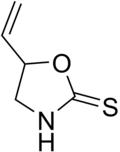 Goitrin
 -
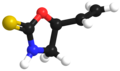 Goitrin 3D Balls


