Fish ladder: Difference between revisions
CSV import |
CSV import |
||
| Line 33: | Line 33: | ||
[[Category:Fish conservation]] | [[Category:Fish conservation]] | ||
{{Fish-stub}} | {{Fish-stub}} | ||
== Fish ladder gallery == | |||
<gallery> | |||
File:Bonneville Ladder.jpg|Bonneville Ladder | |||
File:Ferc-fish ladder.svg|Ferc Fish Ladder | |||
File:Denil fish ladder.jpg|Denil Fish Ladder | |||
File:John Day Dam fish ladder.jpg|John Day Dam Fish Ladder | |||
File:Fischlift1.jpg|Fischlift | |||
File:Grave vistrap laag.jpg|Grave Vistrap Laag | |||
File:CapilanoRiverRegPark-salmonladder.jpg|Capilano River Reg Park Salmon Ladder | |||
File:Climbing Chinook Salmon (15419560541).jpg|Climbing Chinook Salmon | |||
File:Dart at Salmon leap 2.JPG|Dart at Salmon Leap | |||
</gallery> | |||
Latest revision as of 17:53, 3 March 2025
Fish ladder
A fish ladder, also known as a fishway, fish pass or fish steps, is a structure on or around artificial and natural barriers (such as dams, locks and waterfalls) to facilitate anadromous fish natural migration. Most fishways enable fish to pass around the barriers by swimming and leaping up a series of relatively low steps (hence the term ladder) into the waters on the other side. The velocity of water falling over the steps has to be significant enough to attract the fish to the ladder, but it cannot be so great that it washes fish back downstream or exhausts them to the point of inability to continue their journey upriver.
History[edit]
Fish ladders have been used since the time of the Roman Empire. The first recorded instances of their use date back to Julius Caesar's conquest of Gaul, where they were used to help fish bypass obstacles in the rivers.
Design and operation[edit]
The design of fish ladders is based on the swimming capabilities of the species for which the ladder is intended. For instance, salmon are strong swimmers and can leap over obstacles, so the steps in a salmon ladder are relatively high. In contrast, eel ladders are often constructed as a simple ramp with a textured surface to allow the eels to wriggle their way up.
Fish ladders typically consist of a series of small steps, each one slightly higher than the last. The fish swim and leap up the ladder, resting in the relatively calm water of each step before moving on to the next. The height and spacing of the steps are designed to allow the fish to expend as little energy as possible during their ascent.
Effectiveness and environmental impact[edit]
The effectiveness of fish ladders is a subject of ongoing research. While they are generally effective at allowing fish to pass upstream, they are less successful at facilitating downstream migration and can be a significant source of mortality for juvenile fish. In addition, fish ladders can be difficult for some species to navigate, particularly those that are not strong swimmers.
Despite these challenges, fish ladders are considered an important tool for preserving biodiversity in rivers and streams. They allow fish to reach spawning grounds that would otherwise be inaccessible due to man-made barriers, and they can help to maintain healthy fish populations.
See also[edit]
References[edit]
 | This fish-related article is a stub. You can help Wikipedia by adding missing information. |
Fish ladder gallery[edit]
-
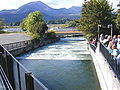 Bonneville Ladder
 -
 Ferc Fish Ladder
 -
 Denil Fish Ladder
 -
 John Day Dam Fish Ladder
 -
 Fischlift
 -
 Grave Vistrap Laag
 -
 Capilano River Reg Park Salmon Ladder
 -
 Climbing Chinook Salmon
 -
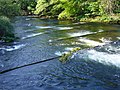 Dart at Salmon Leap


.jpg)

