Electronic voting: Difference between revisions
CSV import Tags: mobile edit mobile web edit |
CSV import Tags: mobile edit mobile web edit |
||
| Line 36: | Line 36: | ||
[[Category:Electronic voting]] | [[Category:Electronic voting]] | ||
{{Politics-stub}} | {{Politics-stub}} | ||
<gallery> | |||
File:ES&S M100 Automark cart.jpg|ES&S M100 Automark cart | |||
File:EVM VVPAT.jpg|EVM VVPAT | |||
File:Electronic voting.jpg|Electronic voting | |||
File:topvoter2.jpg|Top voter | |||
File:Jellybuttons.jpg|Jelly buttons | |||
File:Desi accuvote-tsx vvpat.jpg|Desi Accuvote TSX VVPAT | |||
File:Urnaeleições2006.jpg|Urna eleições 2006 | |||
</gallery> | |||
Latest revision as of 17:47, 3 March 2025
Electronic voting (also known as e-voting) is a term encompassing several different types of voting, all of which involve electronic means of casting and counting votes.
Overview[edit]
Electronic voting technology can include punched cards, optical scan voting systems and specialized voting kiosks (including self-contained direct-recording electronic voting systems, or DRE). It can also involve transmission of ballots and votes via telephones, private computer networks, or the Internet.
Types of Electronic Voting[edit]
There are two main types of electronic voting. The first is the direct recording electronic (DRE) voting system, and the second is the public network DRE voting system.
Direct Recording Electronic (DRE) Voting System[edit]
In a DRE voting system, votes are recorded directly into the computer memory. The voter usually uses a touch-screen, dial, or button to make their selections. The data is then stored in the machine and can be printed out for verification.
Public Network DRE Voting System[edit]
In a public network DRE voting system, votes are cast on a computer that is connected to a network. This allows for the possibility of remote voting, but also raises issues of voter privacy and the potential for vote tampering.
Advantages and Disadvantages[edit]
Like any system, electronic voting has both advantages and disadvantages.
Advantages[edit]
- Efficiency: Electronic voting can be more efficient than traditional paper ballots, with results available almost immediately.
- Accessibility: Electronic voting machines can be made accessible for people with disabilities.
Disadvantages[edit]
- Security: Electronic voting systems are vulnerable to hacking and other forms of cyber attack.
- Verifiability: Without a paper trail, it can be difficult to verify the results of an electronic vote.
Controversies[edit]
There have been many controversies surrounding electronic voting, particularly in relation to security. Critics argue that without a paper trail, electronic voting is not secure and is vulnerable to manipulation.
See Also[edit]
- Voting system
- Direct-recording electronic (DRE) voting system
- Public network DRE voting system
- Internet voting

-
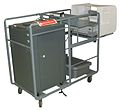 ES&S M100 Automark cart
 -
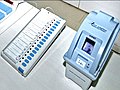 EVM VVPAT
 -
 Electronic voting
 -
 Top voter
 -
 Jelly buttons
 -
 Desi Accuvote TSX VVPAT
 -
Urna eleições 2006


