Beaufort scale: Difference between revisions
CSV import Tags: mobile edit mobile web edit |
CSV import |
||
| Line 35: | Line 35: | ||
[[Category:Wind]] | [[Category:Wind]] | ||
{{weather-stub}} | {{weather-stub}} | ||
== Beaufort scale gallery == | |||
<gallery> | |||
File:Beaufort scale 12 notext.jpg|Beaufort scale 12 notext | |||
File:FrancisBeaufort.jpg|Francis Beaufort | |||
File:Beaufort wind scale.png|Beaufort wind scale | |||
File:beaufort scale 0.jpg|Beaufort scale 0 | |||
File:beaufort scale 1.jpg|Beaufort scale 1 | |||
File:beaufort scale 2.jpg|Beaufort scale 2 | |||
File:beaufort scale 3.jpg|Beaufort scale 3 | |||
File:beaufort scale 4.jpg|Beaufort scale 4 | |||
File:beaufort scale 5.jpg|Beaufort scale 5 | |||
File:beaufort scale 6.jpg|Beaufort scale 6 | |||
</gallery> | |||
Latest revision as of 06:19, 3 March 2025
Beaufort scale is an empirical measure for describing wind speed based on observed sea conditions. It is named after Sir Francis Beaufort, a hydrographer and British Royal Navy officer.
History[edit]
The Beaufort scale was devised in 1805 by Sir Francis Beaufort, an officer in the Royal Navy, to standardize the description of wind force at sea. It was initially used exclusively by the navy, but was later extended to include descriptions of effects on land features as well.
Description[edit]
The Beaufort scale is a scale for measuring wind speeds. It is based on observation rather than accurate measurement. It is the most widely used system to measure wind speed today. The scale starts with 0 and goes up to 12. The Beaufort scale is still in use today, primarily in maritime contexts.
Scale Levels[edit]
The Beaufort scale is divided into thirteen levels, from 0 (calm) to 12 (hurricane). Each level is associated with specific wind speeds, descriptions of the effects on sea conditions, and descriptions of the effects on land.
At Sea[edit]
At sea, the Beaufort scale is used to estimate wind speed based on the physical effects of the wind on the ocean surface. For example, a Beaufort number of 3 corresponds to a gentle breeze and wave height of 60 centimeters to 1 meter.
On Land[edit]
On land, the Beaufort scale is used to estimate wind speed based on the physical effects of the wind on natural and man-made features. For example, a Beaufort number of 6 corresponds to a strong breeze that can cause trees to sway and can make walking difficult.
See Also[edit]
References[edit]
<references group="" responsive="1"></references>

Beaufort scale gallery[edit]
-
 Beaufort scale 12 notext
 -
 Francis Beaufort
 -
 Beaufort wind scale
 -
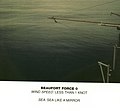 Beaufort scale 0
 -
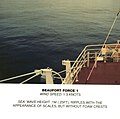 Beaufort scale 1
 -
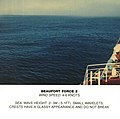 Beaufort scale 2
 -
 Beaufort scale 3
 -
 Beaufort scale 4
 -
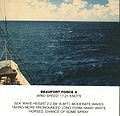 Beaufort scale 5
 -
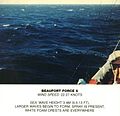 Beaufort scale 6


