Latin obscenity: Difference between revisions
CSV import Tags: mobile edit mobile web edit |
CSV import |
||
| Line 21: | Line 21: | ||
{{Latin-stub}} | {{Latin-stub}} | ||
== Latin obscenity gallery == | |||
<gallery> | |||
File:Mercury god.jpg|Mercury god | |||
File:Sexual scene on pompeian mural 2.jpg|Sexual scene on Pompeian mural 2 | |||
</gallery> | |||
Latest revision as of 06:16, 3 March 2025
Latin obscenity refers to the profane, vulgar, or obscene language and expressions from ancient Roman culture. This topic encompasses a variety of words, phrases, and expressions that were considered inappropriate for polite conversation but were nonetheless part of everyday language, especially in certain contexts and groups. Latin obscenities were not only used in casual and informal settings but also appeared in literary works, graffiti, and even in some political discourse of the time.
Etymology and Usage[edit]
The etymology of Latin obscenities reveals much about the social and cultural attitudes of ancient Rome. Many of these words have roots in terms that refer to bodily functions, sexuality, and genitalia. For example, the Latin word "cunnus" (vagina) and "mentula" (penis) were direct references to genital organs but were considered vulgar. Similarly, "futuere," meaning to have sexual intercourse, was an action not to be mentioned in polite conversation.
Social Context[edit]
In ancient Rome, the use of obscenity varied greatly depending on the social context and the audience. In certain settings, such as the baths or the military, the use of vulgar language was more accepted and even expected. However, in more formal settings or in the presence of women and children, such language was deemed inappropriate. The satirical poets, such as Catullus and Martial, often employed obscenity in their works to critique and mock societal norms, political figures, and personal enemies.
Literary Examples[edit]
Latin literature provides a rich source of examples of obscenity. The works of Plautus and Terence, Roman playwrights, include characters who speak in vulgar terms for comedic effect. Similarly, the poems of Catullus contain explicit sexual references and insults that were considered highly obscene. The "Satyricon" by Petronius, a Roman courtier during the reign of Nero, is another example of a literary work filled with sexual innuendo and obscene language, offering insights into the sexual mores and social customs of its time.
Legal and Moral Attitudes[edit]
The legal and moral attitudes towards obscenity in ancient Rome were complex. While there was no formal system of censorship like in later periods, certain expressions and acts were nonetheless subject to societal disapproval or legal sanctions. For instance, the Lex Scantinia was a law that purportedly penalized certain sexual acts between males, though its application and enforcement remain subjects of historical debate. The moralists of the time, including philosophers and educators, often warned against the use of obscene language, seeing it as a sign of moral decay and a threat to social order.
Conclusion[edit]
Latin obscenity offers a fascinating glimpse into the values, attitudes, and daily life of ancient Rome. While considered vulgar and inappropriate for polite society, obscene language was an integral part of Roman culture, reflecting the complexities of social norms, literary expression, and personal relationships. As such, the study of Latin obscenity not only sheds light on the linguistic practices of the past but also offers insights into the broader cultural and social dynamics of the Roman world.

Latin obscenity gallery[edit]
-
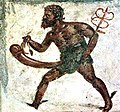 Mercury god
 -
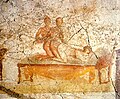 Sexual scene on Pompeian mural 2


