Patoleo: Difference between revisions
CSV import |
CSV import |
||
| Line 39: | Line 39: | ||
[[Category:Goan culture]] | [[Category:Goan culture]] | ||
[[Category:Konkani cuisine]] | [[Category:Konkani cuisine]] | ||
<gallery> | |||
File:Patoli Amchi Style.JPG|Patoli Amchi Style | |||
File:Catholic Goan style Patoleo.jpg|Catholic Goan style Patoleo | |||
File:GC Patoleo prep.jpg|GC Patoleo prep | |||
File:GC Prep Patoleo.jpg|GC Prep Patoleo | |||
File:GC Patoleo ingredients.jpg|GC Patoleo ingredients | |||
File:GC Patoleo smeared rice paste.jpg|GC Patoleo smeared rice paste | |||
File:GC Patoleo filing.jpg|GC Patoleo filing | |||
File:GC Patoli.jpg|GC Patoli | |||
File:GC Patoleo stuffed wrappers.jpg|GC Patoleo stuffed wrappers | |||
File:GC Chondrõ.jpg|GC Chondrõ | |||
</gallery> | |||
Latest revision as of 06:13, 3 March 2025
A traditional sweet dish from the Konkan region of India
Patoleo (also known as Patoli) is a traditional sweet dish from the Konkan region of India, particularly popular in the states of Goa, Maharashtra, and Karnataka. It is a delicacy often prepared during festivals and special occasions, such as the feast of the Assumption of Mary on August 15th and Ganesh Chaturthi.
Ingredients and Preparation[edit]
Patoleo is made using a few key ingredients: rice, coconut, jaggery, and turmeric leaves. The preparation involves several steps, each contributing to the unique flavor and texture of the dish.
Ingredients[edit]
- Rice flour
- Freshly grated coconut
- Jaggery (a type of unrefined sugar)
- Turmeric leaves
- A pinch of salt
- Water
Preparation[edit]
The preparation of Patoleo begins with soaking rice and grinding it into a fine paste. This paste is then mixed with a pinch of salt and water to form a smooth batter. Freshly grated coconut is combined with jaggery to create a sweet filling.
The turmeric leaves, which impart a distinct aroma and flavor, are washed and dried. A small amount of rice batter is spread onto each leaf, followed by a layer of the coconut-jaggery mixture. The leaf is then folded, and the edges are sealed to encase the filling.
The wrapped leaves are placed in a steamer and cooked until the rice batter is firm and the aroma of turmeric leaves is infused into the dish. Once cooked, the leaves are peeled away, revealing the sweet, aromatic Patoleo.
Cultural Significance[edit]
Patoleo holds a special place in the cultural and religious traditions of the Konkan region. It is often associated with the monsoon season and is a staple during the harvest festival. The use of turmeric leaves is symbolic, representing purity and auspiciousness in Hindu rituals.
In Goa, Patoleo is traditionally prepared on the feast of the Assumption of Mary, celebrated on August 15th, which coincides with India's Independence Day. It is also a popular offering during Ganesh Chaturthi, a festival dedicated to the Hindu deity Ganesha.
Variations[edit]
While the basic recipe for Patoleo remains consistent, there are regional variations in its preparation. In some areas, additional ingredients such as cardamom or nutmeg may be added to the filling for extra flavor. The type of rice used can also vary, with some preferring red rice for its distinct taste and nutritional benefits.
Related pages[edit]
-
 Patoli Amchi Style
 -
 Catholic Goan style Patoleo
 -
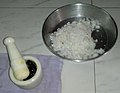 GC Patoleo prep
 -
 GC Prep Patoleo
 -
 GC Patoleo ingredients
 -
 GC Patoleo smeared rice paste
 -
 GC Patoleo filing
 -
 GC Patoli
 -
 GC Patoleo stuffed wrappers
 -
 GC Chondrõ


