Volcanic eruption: Difference between revisions
CSV import Tags: mobile edit mobile web edit |
CSV import |
||
| Line 39: | Line 39: | ||
{{Geology-stub}} | {{Geology-stub}} | ||
{{No image}} | {{No image}} | ||
== Volcanic eruption gallery == | |||
<gallery> | |||
File:Lava forms.jpg|Lava forms | |||
File:VEIfigure en.svg|VEI figure | |||
File:Hawaiian Eruption-numbers.svg|Hawaiian Eruption numbers | |||
File:Hawaiian Eruption-numbers.svg|Hawaiian Eruption numbers | |||
File:Ropy pahoehoe.jpg|Ropy pahoehoe | |||
File:Strombolian Eruption-numbers.svg|Strombolian Eruption numbers | |||
File:Strombolian Eruption-numbers.svg|Strombolian Eruption numbers | |||
File:Stromboli Eruption.jpg|Stromboli Eruption | |||
File:Vulcanian Eruption-numbers.svg|Vulcanian Eruption numbers | |||
File:Vulcanian Eruption-numbers.svg|Vulcanian Eruption numbers | |||
</gallery> | |||
Revision as of 06:06, 3 March 2025
Volcanic Eruption
A volcanic eruption is a geological phenomenon that occurs when there is a sudden release of magma, gas, and other materials from a volcano. This process is driven by the internal geothermal energy of the Earth, which causes the magma to rise to the surface through cracks in the Earth's crust, known as vents.
Types of Volcanic Eruptions
There are several types of volcanic eruptions, classified based on their nature and intensity. These include:
- Effusive eruptions: These are characterized by the outpouring of lava onto the ground. The lava flows slowly and steadily, creating new layers of rock.
- Explosive eruptions: These are violent eruptions that can blast rocks, ash, and gas into the atmosphere. They can cause significant damage and are often associated with stratovolcanoes.
- Phreatomagmatic eruptions: These occur when water comes into contact with magma, causing a steam-driven explosion.
- Strombolian eruptions: Named after the Stromboli volcano, these eruptions are characterized by the ejection of incandescent cinder, lapilli, and lava bombs.
Effects of Volcanic Eruptions
Volcanic eruptions can have both positive and negative effects on the environment and human societies. On the one hand, they can cause loss of life and property, disrupt air travel, and lead to climate change. On the other hand, the ash and lava released by eruptions can enrich the soil and create new landforms.
Volcanic Eruption Monitoring and Prediction
Scientists use a variety of methods to monitor and predict volcanic eruptions. These include seismology, gas chromatography, thermal imaging, and satellite imagery. Despite these methods, predicting the exact timing and scale of an eruption remains a challenge.
See Also
References
<references />

Volcanic eruption gallery
-
 Lava forms
 -
 VEI figure
 -
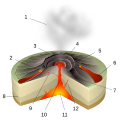 Hawaiian Eruption numbers
 -
Hawaiian Eruption numbers
-
 Ropy pahoehoe
 -
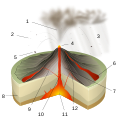 Strombolian Eruption numbers
 -
Strombolian Eruption numbers
-
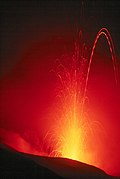 Stromboli Eruption
 -
 Vulcanian Eruption numbers
 -
Vulcanian Eruption numbers


