Temporal dynamics of music and language: Difference between revisions
CSV import Tags: mobile edit mobile web edit |
CSV import |
||
| Line 23: | Line 23: | ||
{{Linguistics-stub}} | {{Linguistics-stub}} | ||
{{Music-stub}} | {{Music-stub}} | ||
== Temporal dynamics of music and language gallery == | |||
<gallery> | |||
File:PET-MIPS-anim.gif|PET-MIPS animation | |||
File:NIMH MEG.jpg|NIMH MEG | |||
</gallery> | |||
Latest revision as of 06:03, 3 March 2025
Temporal dynamics of music and language refer to the way in which time is organized and structured in music and language, respectively. Both music and language are temporal arts, relying on the passage of time to convey meaning, emotion, and structure. The study of their temporal dynamics involves understanding how elements such as rhythm, tempo, and timing contribute to the perception and production of music and language.
Temporal Dynamics in Music[edit]
In music, temporal dynamics are primarily concerned with rhythm, tempo, and meter. Rhythm refers to the pattern of sounds and silences in time. Tempo is the speed at which a piece of music is played, typically measured in beats per minute (BPM). Meter describes the recurring pattern of beats in a piece of music, organized into measures. These elements work together to create the temporal structure of a piece of music, influencing how it is perceived and experienced.
Temporal Dynamics in Language[edit]
Language's temporal dynamics are evident in prosody, which encompasses elements such as intonation, stress, and rhythm of speech. Prosody plays a crucial role in conveying meaning, emotion, and structure in spoken language. The timing and duration of phonemes (the smallest units of sound in a language), syllables, and words also contribute to the temporal dynamics of language, affecting speech clarity and intelligibility.
Comparison and Interaction[edit]
Comparing the temporal dynamics of music and language reveals both similarities and differences. Both rely on temporal sequencing and have hierarchical structures that organize time in complex ways. However, the specific functions and manifestations of temporal dynamics differ, with music often focusing more on aesthetic and emotional expression, and language on semantic and communicative functions.
The interaction between music and language's temporal dynamics is a rich area of research. Studies have shown that musical training can improve certain aspects of language processing, such as phonemic awareness and prosody perception. This suggests that the temporal dynamics of music and language may share underlying cognitive mechanisms.
Conclusion[edit]
Understanding the temporal dynamics of music and language offers insights into their fundamental nature and the cognitive processes underlying their perception and production. This knowledge has implications for fields ranging from education and linguistics to cognitive neuroscience and artificial intelligence.

This article is a linguistics stub. You can help WikiMD by expanding it!

Temporal dynamics of music and language gallery[edit]
-
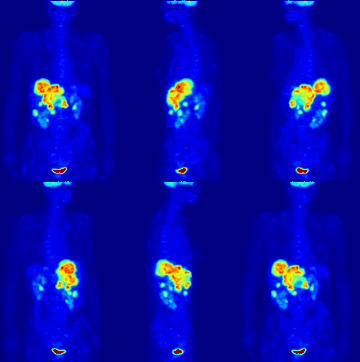 PET-MIPS animation
 -
 NIMH MEG


